28.9.26
BE THE LIGHT IN SOMEBODY’S LIFE JUST BECAUSE YOU CAN

Short and sweet with this week’s thought. You make a positive difference, whether it’s in your project team or in the worder in the world. Be the light in somebody else’s life just because you can. The darkness of too much to do, not knowing what to do, not believing they can – none of these things is any match for your light of possibility. Why settle for being a small light when you can be as bright as a chandelier and light the way for the whole team – or even more? Who are you not to shine so brightly?
8.9.26
Us
A simplistic view of life might have you believe there are only two groups of people in a team – Them and Us. We already covered Them a while back, so this week I’ve been thinking about Us. Who are Us? Yes, I know that’s grammatically incorrect, but let’s not get sidetracked by that little detail…
If Them are the convenient target to blame for everything that goes wrong, that must make Us the cause of everything that goes right. The creative ideas that lead to the detailed and fabulous plan that anticipates everything that could possibly go wrong and deals with it before it can happen. The ones who understand what the plan requires and then set about doing it with complete certainty. The ones who are easy-going and easy to work with, totally tolerant and supportive. The ones the team needs to keep Them on task and up to the appropriate performance standards.
In other words, any problems in our team can’t be down to Us because Us fix problems rather than causing them.
It’s great to be Us, because we certainly wouldn’t want to be Them…
Let me just ask these questions: Are Us so perfect? Is there nothing Us could do to collaborate more effectively with Them? If nothing was off the table, what could we do to have a more inclusive and productive Us where there was no reason for there to be Them…?
31.8.26
I’m in favour of the CIA Leaders…
Before you think there might be some political overtones to this week’s thought, or a good spy story, I’m going in a different direction. When I think of all the leaders I’ve worked alongside across diverse industries and in different organisations, their different genders, ethnicities, orientations – you name it – the ones I have the most respect for are the CIA ones.
Let me translate:
Caring – they genuinely care about the people in their team., Not surface care – really care: about who they are, about what they think, about what they feel, about the reasons behind those things, about what they need to help them be better at what they do (and able to do more and different things).
Inspiring – they understand that the example they set through what they do (not just what they say) is the example that team members will react to and either reject or aspire to. They want people to come on the journey with them, and having to tell them to get on the journey just isn’t their style.
Authentic – they are honestly themselves. That means they are brave enough to admit when they don’t know the answer, brave enough to say how they feel, brave enough to try things that take them out of their comfort zone and reflect honestly about the experience. They are real people, just like everybody else in their team, and they don’t try to be somebody they are not because they think that’s who somebody else expects them to be.
They understand the team will work more effectively if they are a part of it rather than being apart from it.
28.7.26
Politics and teamwork sometimes (unfortunately) share the same fools
It’s been a long time since I’ve shared my thinking. That doesn’t mean I haven’t been doing any thinking lately, so I do have lots to share with you. I just had something I needed to take care of in the background, which is pretty much done now. I’m going to start with a view that might be a little bit controversial this week, so let’s see how that goes…
As we come up to “election silly season” I’m struck by the way that both politics and teamwork sometimes (unfortunately) share the same fools. You may have come across them. The ones who state loudly and continually that whatever problem they are trying to deal with was caused by “that other lot.”” The ones who tell you not to blame them for the solution, because it’s not really their fault. The ones who take great delight in pointing out just why those decisions made by “that other lot” were so bad – but who rarely put forward any of their own ideas or the detailed thinking behind them. The ones who seem driven more by their own ego than the desire or need to act collaboratively. The ones who won’t accept any viewpoint other than their own as being relevant or correct.
You may approach what they think/say and do with an open mind – that’s what you think you do – because that’s how you get the opportunities to learn more about why they think or do those things. You may clarify your expectations, what your team are looking for, and what is important to your project’s wider stakeholders multiple times, and in different ways, trying to get your message through in a way that lets you know you have been seen and heard.
Sooner or later, you need to make a decision, though. Are you going to keep them as part of your team when they have shown an inability to think and act collaboratively in the best interests of as many stakeholders as possible, or are you going to act to exit them from the team? If the latter, are you acting because they don’t think/act like you, or are you acting for the genuine and provable good of the team or your project’s wider stakeholders?
If you make the decision to exit them, do it with grace and allow them dignity. If that’s not how you feel you’ve been treated by them, that doesn’t mean you have to play the game their way. Your argument – if that’s a term you want to use – is with the other person’s ideas rather than with them as a person, so make sure that’s where you keep it. Be the bigger person who understands and shows in their actions that Together Everyone Can Achieve More. Creating division where none need exist is a losing game.
29.3.26
NEW GROWTH – – NOW IS NOT MY LIMIT

I’m sharing this thought out of the sequence I had planned for this year’s thinking. That’s important, because good plans allow for contingency events. The contingency event in this case is that I am literally days away from submitting the amended thesis and associated artefacts for my DProfPrac qualification. Having spent a long time working on this, I’m not sure exactly how I feel about waking up one day this week and realising “I don’t need to think about this thing today, or tomorrow, or the next day…”
In the last couple of weeks, I’ve rejigged many things in my regular routine to focus on finishing this thing, in all its various parts. One of the things I’ve missed the most are the regular photographic mindfulness opportunities, even though I’ve got a big one planned for after I submit everything. Short-term investment of time for longer-term gain right now – at least, that’s what I’m telling myself…
This image I created in our garden this morning symbolises my story right now. The single bloom represents my career as an educator – plenty of passion and `out there` in my field. You notice those petals just starting to go off around the edges? Those are a sign that the plant’s energy is being reallocated. Look above the bloom. See that new growth? That’s the potential supporting new blooms that may be even more fabulous than the first one was. In my case, these are the new adventures made possible by the journey that concludes in a few days.
Here’s to the new bloom.
17.3.26
THEM

Do you know who are the busiest people connected with your project and your team? No matter how busy YOU are, the answer may – or may not – surprise you. It’s THEM – THOSE OTHER PEOPLE. The faceless ones, the headless ones…
I long ago stopped counting the number times I heard this with student project teams. You might think that’s not surprising, because they are still learning about things like collaboration and the mysteries of managing projects. You are thinking I should maybe have some sympathy here – remembering back to my own first project – and cut them some slack (as long as the regularity of hearing about THEM drops as projects progress).
You might expect I would hear that less with working professionals, because they live in a world where much of what they do has a collaborative component to it, even if they aren’t working on `projects`. To be fair, I have heard it less with the professionals than the students, and that’s across diverse industries and organisations over many years now – but I still hear it.
What does the involvement of THEM mean? Sometimes THEM are a convenient target for blame if things don’t go the way that you planned. THEM are an even more convenient target if you didn’t do the planning you should have.
THEM are a convenient excuse for not reflecting on your own thoughts and actions (or lack of actions, as the case may be). THEM are a convenient excuse for not being as objective as you could be when assessing your thoughts and actions.
THEM are NOT the reason for everything that happens to you, your team, and your project. THEM don’t have to be reason for everything you think and do. YOU may not have the answer to every question, but THEM can’t stop YOU looking for those answers, collaborating to try different options until YOU collectively create the best outcome you can.
YOU have more creativity than THEM. YOU are more invested in yourself, your team, and your project than THEM. YOU have more potential than THEM can stop. YOU have stronger willpower than THEM can stop. When their voices try telling you that you can’t stand against THEM, your response is YOU already have, YOU are, and YOU aren’t about to stop, because YOU believe in YOU even if THEM don’t.
THEM don’t have control over YOU. THEM can either get on board or get out of your way. There’s one thing for sure: THEM don’t have permission now – if they ever did – to stay in your way.
10.3.26

Try
How do you know something won’t work? How do you know you won’t be able to do it, or you won’t be very good at it?
If it’s because somebody else said so, how do they know? What evidence have they put forward that says you should trust their judgement?
If it’s something you haven’t done before, or something where you aren’t at the achievement level you want to be, there’s one way I know that will get you were you need to be. If you are like me, you want to be REALLY good at what you do, and I can recommend this one way for getting there.
TRY!
I will use my photography journey as an example. Ten years ago, when I first decided I wanted to get into photography with something more than point-and-shoot gear, I was basically doing snapshots. Nothing wrong with that if it’s what you want, but it wasn’t what I wanted. I’ve read books, gone to some in-person courses at night school, and lost count of the library of YouTube videos I’ve watched. All these things are important parts of my improvement as a photographer.
The one thing that’s worth more than all these things together (in my opinion) is the commitment to TRY. Ten years ago, there’s no way I could have produced an image like this week’s one. Ten years of TRYING means I have discovered a niche (flower photography) that I’m happy in, and where there are still so many other things I’m interested to TRY.
The same thinking applies to teamwork/collaboration and projects. If you don’t TRY, you won’t know what you are capable of. If you don’t TRY new things, or different ways of doing old things, you will keep getting what you’ve always got. If that’s not the result you want, it’s time to TRY something different. You might just be surprised at how good you really are if you keep at it.
3.3.26
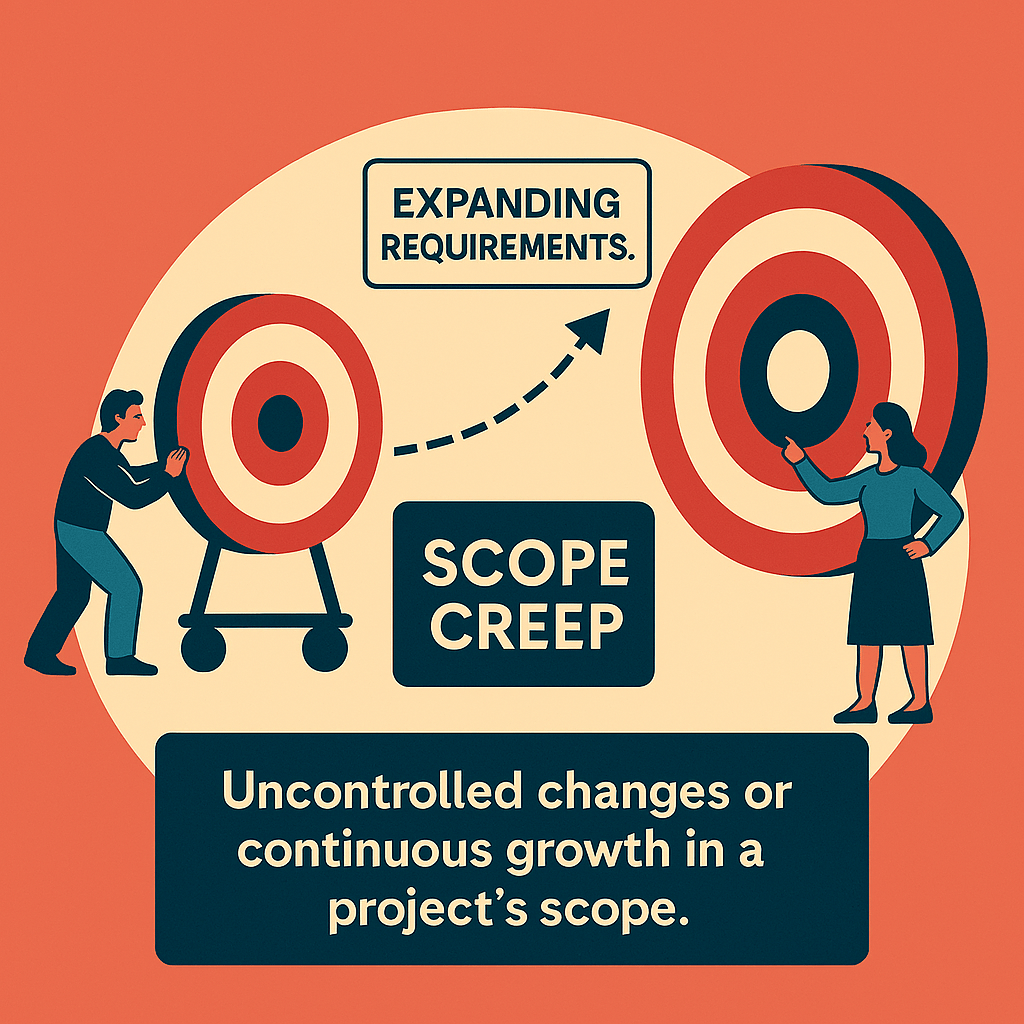
Scope creep
Something I’ve often found that learners underestimate the prevalence or importance of is scope creep.
They work out with the Project Sponsor what the project is going to be all about, and then they lock that down in a Project Agreement or contract of some sort. They have a project plan all sorted out – everybody knows who’s doing what, and what the timeline looks like. They’ve probably built some contingency time into that. Providing everything follows the plan, there shouldn’t be any problem…
Too often, what they don’t notice, or don’t appreciate the significance of, is the development of project creep. It’s not uncommon for nobody on the team to refer back to the Project Agreement to compare that with what’s actually happening,
- We can do something differently, make some aspect of the project a little better than we were asked for (because we wouldn’t want to under-deliver, but over-delivering should be OK…).
- We can add a feature to this part of the project – we weren’t asked for it, but we are sure we would be if the Project Sponsor was thinking further ahead. We’ll just get one step ahead of them because we can…
- The Project Sponsor reinterprets one or more parts of what they originally asked for – just a little bit here and a little bit there – but all those little bits add up…
None of this is to say that Project Agreements can’t be changed. Indeed, there are often good reasons why changes should happen. What’s important, though, is that these should be negotiated against the Project Agreement. Think about what can be done with the resources you have available, and those you could reasonably access.
Ideally this thinking should happen before things get changed. There’s no reason, though, why it can’t happen after a change has taken place. It may take a brave conversation for this to happen, but you don’t need to accept the crept state of a project as the state that has to exist. Whatever you are doing has to be achievable, and if your team aren’t managing scope creep you will find it managing you.
Because scope creep can affect any part of a project, it’s something that everyone in the team should be checking for. Don’t leave it for somebody else to do for you. Every member of the team shares responsibility for this because you aren’t just there with each other – you are also there for each other.
One last thing worth thinking about here: the relationship between scope creep and minimum viable product. One reason sometimes put forward to justify scope creep is avoiding Minimum Viable Product, because that “minimum” might actually end up being less than enough. This is certainly one I’m familiar with at the tai lend of my doctoral research project, and it’s led to some interesting conversations and decisions, because I’m having to balance my inherent perfectionism against what’s necessary to achieve the contracted outcome. Instead of letting (or forcing) the current project to creep, there’s scope for some more projects off the end of this one. Controlled creep could lead to places that uncontrolled creep never will – but it’s an adventure I have to be prepared to have to find out where it leads.
With an open mind creep can be turned into controlled rather than uncontrolled change.
23.2.26

Depth of field
I’ve been doing some thinking recently about depth of field. This is something I’m normally thinking about in terms of my photography. This week’s image is a great example. Because I wanted to focus on the flower, I deliberately positioned myself relative to the flower I was interested in so that the moss-covered tree trunk in the background behind it appeared blurry. Had I positioned myself differently, used a different lens and aperture setting, this could have been an image with a lot more sharp detail overall – but the flower wouldn’t have stood out the way my vision called for it to do.
Project work and collaboration aren’t that different from photography when it comes to depth of field. Where you are coming from, where you are looking to get to, and the choices you make about how you could get there, will determine what you achieve. Maybe you try a few options to see what gives you the optimum result for your needs (time and other resources permitting). Document what you do – you never know when that information will, come in useful for solving future problems or taking advantage of future opportunities.
You might have somebody in your team who excels at seeing shallow depth of field. That’s an advantage if you are looking to focus on the issue, they are most interested in. Maybe somebody else in your team excels in seeing the bigger picture and story it tells when all the details are in sharp focus. Maybe you have somebody in your team who’s great at moving between different depths of field – the all-rounder rather than the single-issue or task specialist.
My point is that there is no one `right` depth of field (meaning any others are somehow `wrong`). There are choices you need to make, and the best ones are likely to come from a combination of trial and error, as well as plenty of conversation. As long as you accept that there is usually more than one way to solve a problem or take advantage of an opportunity, getting the appropriate depth of field doesn’t have to be `hard work` – it can be a lot of fun (and it’s definitely adding to your knowledge basket).
9.2.26

SUPPORT
Something that you will often hear mentioned in relation to working collaboratively is the need to support people, because there will be times when they can’t do whatever they need to do on their own. Your team may have this as a formally expressed expectation, or it may be one of those things that everybody “just knows” (even though they don’t share a definitive meaning for it).
If the latter is the case – as it usually is, in my experience – it’s time to start thinking about what support really means. Is it:
- Something that only happens if it is specifically asked for?
- Something that comes with conditions (for giving or denying) attached to it?
- Something that is offered or given to some team members more than others?
- Something that is given voluntarily, or that needs an instruction or an order before it is given?
- Something that is given to somebody who either doesn’t ask for it or specifically turns it down when offered?
- Something that is limited to only the resources that the team has available internally at the time?
You might look at these questions and think that the answers are self-explanatory. Maybe they are. I can think of plenty of situations that I’ve been involved with or known about over the years where self-explanatory didn’t happen. From them all comes one of the most valuable pieces of advice I can ever share: Instead of trusting that self-explanatory will somehow come true – especially as a shared meaning – have the brave conversations about what support could mean for your team. Have them right from the start of the team’s life. The most successful teams get the practicalities of support agreed early on – that gives them more time and emotional energy to invest in working towards their goals and objectives.
Debate it. Agree it. Do what you said you would. Simple. Your team is as strong and capable as you empower yourselves to be.
2.2.26


Negative and Positive – A Choice
To the world:
When you choose to see only your negative perceptions of me, you do not see all that I am, and all that I can be.
To me:
When I choose to see negative perceptions of me, whether those of others or my own, I do not see all that I am, and all that I will be.
The choice
What we see represents deliberate choices, leading to outcomes that are largely predictable. We must choose wisely so as to be pleasantly surprised at the outcomes..
26.1.26

Relationships (working)
Let’s assume you’re in a project team. It’s a team you were really keen on getting into, and you’re working on a project that you either do have; or can have some passion for. To get into the team you had to demonstrate that you’ve got appropriate Knowledge, Skills, Abilities, and ATTITUDE.
Now you’re in, what kind of relationships are you going to have with your fellow team members?
- Interact with them when you have to and not otherwise?
- Have some that you would much rather interact with than others?
- Actively avoid interacting with some of them as much as possible?
- Based only in the context of the project?
- Both inside and outside the context of the project?
- Where you already know everything you need to know to make this project happen?
- Where learning from others in the team is a little bit “unknown territory”?
There are some important realities at play here:
- Your fellow team members are trying to answer pretty much the same questions at pretty much the same time.
- None of you know exactly what the answers are going to be.
- Deep down, you all know that you’ll achieve more together if you explore the answers to these questions with genuinely open minds.
- The answers are probably going to change over time as you get more used to working with each other in practice.
There are some cautions worth mentioning here:
- If you are trying to be somebody you really aren’t, you will be found out sooner or later – and that will definitely effect relationships within the team. Be the authentic you.
- Accept that other people are allowed to be who they are – even if that’s not a carbon copy of you. Diversity can bring a strength to the team that having multiple copies of you never will.
- If you have the opportunity to pick your best friend for the team, do it because they are the right match for what the project and team need – not just because they are your best friend (unless you are willing to put that friendship on the line for the project if necessary).
- Nobody is asking you to fall in love with everybody in your team but, at the very least, you should be able to practice professional respect for each other. Having said this, I did once have two members of the same cohort fall in love and get married…
Relationships within your project team are just like all the ones you have outside the team – they constantly evolve. Some of the most brilliant relationships I’ve ever seen in project teams are the ones where I wouldn’t have out those people together if all I knew about them was based on their formal records. Equally, some of the most painful relationships have been those where – on paper, at least – it looked like those people were pre-destined to work together.
What you get from being in a team relationship is connected with what you are prepared to put into it. Even if you’ve had a bad team relationship experience previously, that was then. This new experience is now, and unique. Be that person you “sold” yourself as to get into the team, because that’s who the rest of the team think they are in a relationship with.
20.1.26
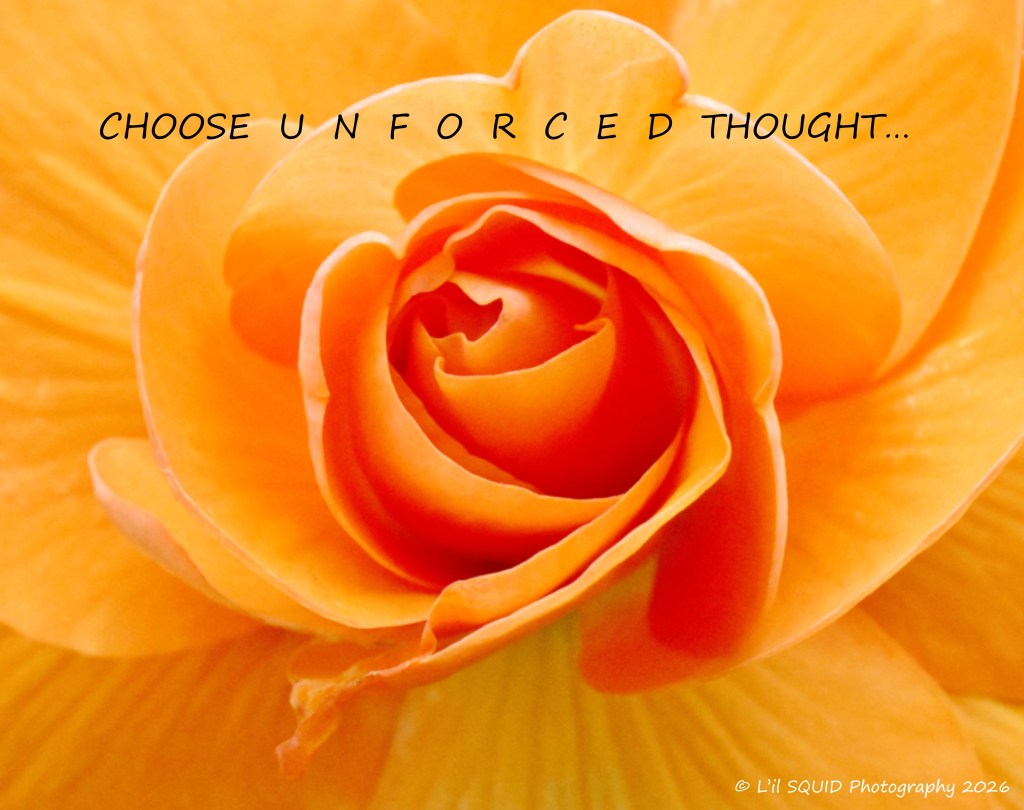
Choose U N F O R C E D Thought
Yesterday was a public holiday – our provincial anniversary. I had other things I “should” have been doing. Work things. Study things. What I chose to do for half the day was get up early, take a bus, train, and two more buses to get to my Happy Place (Wellington Botanic Garden) for several hours of Photographic Mindfulness.
In the background was a problem I’d been trying to resolve for some time without success. After a few hours in the fresh air and flowers, the way forward with the problem was clear., Not because I’d sat there and consciously thought about it in front of a computer and surrounded by appropriate resources. Because I chose U N F O R C E D Thought.
While my conscious mind focused on things like the images I could create, and breathing – being in the moment – my unconscious mind engaged in a different type of thought. With no conscious direction or enforced constraints, the problem I had been stopped by ended up solved after a few hours in the fresh air wandering around the gardens, creating beautiful images like this week’s. In hindsight, perhaps I should have engaged in U N F O R C E D Thought earlier. Now all I need to do is finish writing the content that goes with the thought – and that’s a good problem to have.
If you have a problem, I highly recommend some U N F O R C E D Thought. It’s a great way of creating some more creative time without consciously doing any more work.
13.1.26
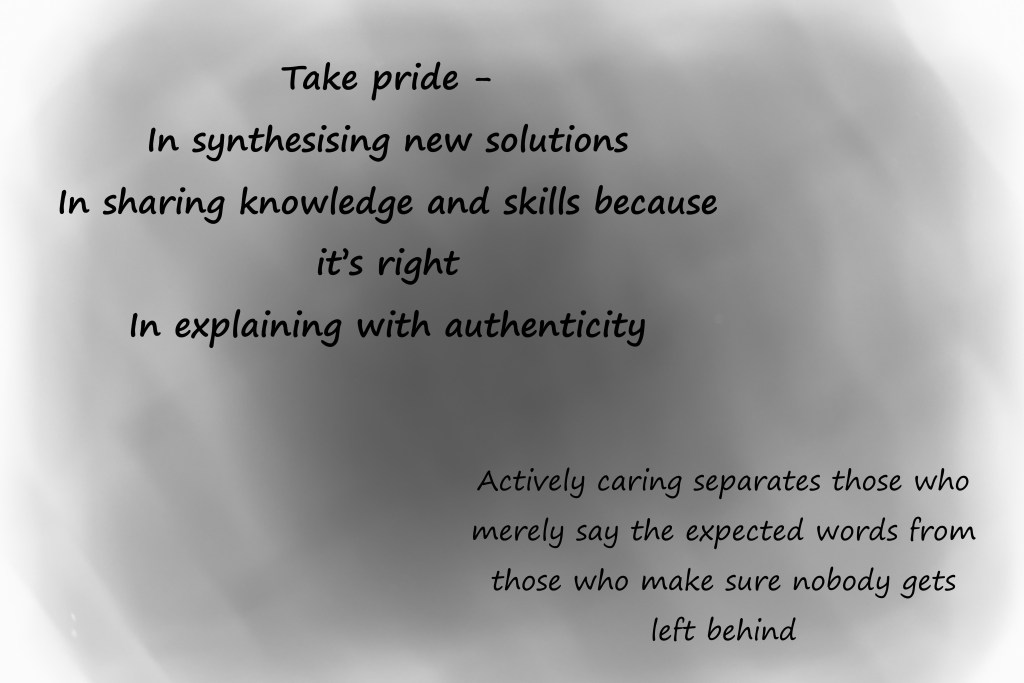
Take pride in what you do
A while back I was asked in a job interview what I was most proud of. It was obvious the panel wanted to see if I would mention something that had a direct connection to the specific disciplines the role would involve facilitation for. By that stage, I thought I’d established that the journey I’d been on over all the years it took to reach this interview was something to be proud of, with the learning experiences supporting the various qualifications attained, as were all the learners I’d guided (coached, mentored – whatever term you want to insert here) to achieve things that they believed were impossible for them.
What I mentioned instead – which was fairly obviously not what they were expecting – were the learners who, having reached out for help, had taken the courageous decision not to unalive themselves. I could say that my pride lay in the fact they felt comfortable enough to include me as the person they opened up with, and that wouldn’t be entirely untrue. There are some things that are more important (for me), though:
- The people they went on to become, and the difference they have been able to make in the world.
- The thinking that lay behind how I worked with them so they could reconnect with their potential.
At the time, I would have said my thinking was a blend of “common sense”, lived experience, what I learned from my formal study of business psychology and leadership, intuition, what I thought I knew about each individual and their circumstances, and a degree of luck that positive outcomes were achieved.
Looking back now I only have the final changes to make on my doctoral thesis, I realise that all those things came together to form the foundation of the LAMB CHOPS and MINT SAUCE Model for collaborative project work. A bit of a mouthful of an acronym, but it represents a menu-based approach to learning and practicing the skills and attitude needed for successful collaboration. Those are the same things I shared with each of those learners – in a combination customised just for them- – even before the model was a formal “thing.”
Yes, there are formal and informal mentors and assessors, as well as literally thousands of teachers (because I have learned from every one of my own learners) over the years who have helped form the model into its current iteration. Each one of those people have played an invaluable part in how the Knowledge, Skills, Abilities and ATTITUDE (KSAA) Model has evolved from LAMB CHOPS and MINT SAUCE. I’m proud that with their input, I’ve been able to create and share something that not only helps bring out and enhance people’s inherent strengths as collaborative learners, but can also quite literally save a life.
I might have given the wrong answer for that panel and what they had on the Job Description and Person Specification to get that particular job. For me, it wasn’t the wrong answer to the question, because it was authentic. In hindsight, the fact the panel didn’t appreciate it is a signal that the job wasn’t the right fit for me. Best piece of advice from me to me: Be true to who you are and your values. Your real value doesn’t lie in saying what is convenient – it lies in doing something that adds value to others, empowering and equipping them to be their most awesome selves.
Question for you: When was the last time you were true to yourself while serving others, and what difference did it make?
27.12.25

If that was 2025, that was it…
Welcome to my last Thought fort the Week – an overall Thought for the Year – for 2025. Christmas Day has been and gone, relaxation was had, as well as a sufficiency of food and drink. The sunshine was happening, the temperature pleasant, and the company awesome. All in all, it was the sort of laid-back “us” day that we should gift ourselves every now and again without needing to connect it with a significant religious or other event.
Maybe that means rethinking the concepts such as “work”, “progress”, “performance”, “care for others”, and (especially) “self-care.” These are themes that I’ve covered in my regular thinking over the last two years, especially in relation to Collaborative Team-Based Project Learning (CTBPL). I don’t pretend to have all the answers, but my lived experiences across diverse industries and organisations have helped me identify and explain important truths as part of, and going beyond, my work towards a Doctor of Professional Practice (DPP) in Educational Leadership.
It’s been a full-on year, that’s for sure. Last month, I finally reached two points that had been so long coming I was almost believing they were mythical. First was the submission of what I referred to (half-jokingly) as the Thesis Monster Thingy and its Book Sibling, for the DPP. Second was having the professional conversation to discuss all the learning that came from creating them and how that has changed me as a thinker about, and practitioner of CTBPL.
Yes, I still have a couple of months to run on the final revisions, but the end of this part of my life and professional journeys is finally in sight If I had to apply one word to describe the journeys, what would it be? Probably “Persistence” (with a capital P).
There have been plenty of times when I was tempted to walk away. Persistence stopped me from doing that, because I wanted to see how things turned out in the end. That’s the same Persistence that’s stopped me giving up on learners who may be giving up on themselves; or have already given up. It’s the same Persistence that’s been shared with learners to support them in refining their ability to more effectively lead themselves and others, because I believe in them until they give me a reason not to. Even then that doesn’t mean I will give up on them, because I’ve started from the point that they have potential worth fighting for.
There will definitely be plenty of “Persistence” happening next year (and beyond) too. That’s the best way I know to pay forward all the support I’ve had over these combined journeys of mine, as well as sharing the benefits of my lived and observed experiences. 2026 will mark my 28th year of living a commitment I made to empower other learners and facilitators in the CTBPL space as part of my initiation into the challenges of collaborative project work with the Applied Management course at the former Central Institute of Technology.
Weekly thinking will resume early in the New Year.
10.12.25

Re-do…
Among the most dreaded words that can be uttered in a team project is “Re-do.” Dreaded because it implies judgement has happened. Dreaded because for the person on the receiving end of the judgement may take the need to make changes to something they’ve worked hard on as a judgement against them personally rather than as a Learning Moment connected with the work. Dreaded for the person saying those words because they may have a negative feeling about how they are going to be perceived as the messenger (at the expense of focus on the message).
If you are the person communicating the need to re-do something, you should choose your words carefully. Run the soundtrack in your head before the words come out; or read the communication as if you were the person receiving it. How would you feel if you were on the receiving end? Every re-do situation I’ve ever been part of always has something positive in it – something that was done right/done well, and that can be built on for the second attempt. Those things are worth looking for because they are like little nuggets of gold – incredibly valuable.
How to handle a re-do communication?
- Focus on the task rather than the person.
- Find the things that were done well, especially if they were difficult things to do in the first place, and make sure the person knows these things are appreciated.
- Be very clear about what needs to change, why, and what it needs to look or sound like once the change is made.
- Specify any performance parameters that need to be met, check that these are clearly understood, that they can be achieved within existing resources, and any additional resources that may be needed.
- Cleary identify what assistance will be available to help the person re-do the task, because real teams collaborate to achieve outcomes.
If you are the person receiving the need to re-do something message, make sure you ask plenty of questions. Even if you feel a bit reticent about this, the outcome is usually a lot more positive than making assumptions that turn out not to be true.
Yes, a re-do situation can be frustrating if it means various parts of your project plan need to be adjusted. It can also be a collection of fabulous Learning Moments where you end up with a much better deliverable, as well as some deep learning that you would otherwise have missed out on. How you choose to handle a re-do situation will determine your outcome.
2.12.25
Right

There are seven questions worth asking in connection with any project. -The first six are ones you will be well familiar with – Who, What, When, Where, Why, and How. The seventh one may be the one you end up asking the most or making as some sort of definitive statement, because it’s the one that attaches to every one of the others. That’s the one about what is Right.
The supposed existence of “right” ideas or “right” answers implies that there must be others that are “wrong.” Who determines what is “right” and what is not? What criteria are they using, how have they been established, and how much (if any) flexibility do they have? Are they situational or do they never change? Whose voice is paid the most attention, and what does that mean for other voices?
Whether it’s a question, a justification, or a label, “right” needs an explanation, rather than an assumption it will be accepted simply because it’s the first idea put forward, or the one most strongly promoted at any given point in time. “Right” should be an invitation to a conversation rather than an end to one.
25.11.25
REWARD

There are plenty of sayings around to the effect that people won’t perform unless given rewards. There are also plenty of stories about what happens when the rewards don’t motivate performance in the first place; or stop having the desired effects after a while. There’s also the vexed issue of requests (or demands) for rewards that seem to be out of line with what needs to be accomplished in the first place.
Despite all my lived experience across diverse industries and organisations, I’m not going to prescribe a `definitive list of rewards that work` – because I’m not sure that such a list actually exists.
Instead, I’m going to share some questions with you that I think are worth having conversations about – you might be surprised at the answers.
- Are you rewarding expected performance, or exceptional performance? How do you define each of those terms?
- Are rewards going to be for teams, individuals, or both? Are team rewards able to be split unequally across individual members, and what’s your process for doing this?
- Are the criteria for earning rewards clearly established? How do you know the meanings of those criteria are commonly shared across the team?
- Do you have any say over what form the reward can take? How much scope do you have to work within a range of rewards?
- Do you have a process for not giving a reward that was previously agreed before a task started? What processes have you got for avoiding the possibility of this happening in the first place?
These questions have been about you in relation to a team. You also need to be thinking about you as an individual – this is more intrinsic thinking than with the previous questions.
- What kind of project does it feel right, or feel good for you to be working on? The opportunity to be involved in the particular work may be a unique reward for you.
- What is it that makes you want to be involved with this team, and contribute to its success? The opportunity to form meaningful relationships can be a reward on its own.
There are some important points to bear in mind for effective rewards.
- They don’t have to cost a lot of money or involve big, tangible things.
- You may rate the opportunity to have an experience as being just as valuable to you.
It’s been a few weeks since my previous post. That wasn’t part of how things were meant to happen, but it’s what ended up being necessary heading into the professional conversation wrapping up the substantive work on my doctoral project. Having achieved the provisional outcome that I was working towards, my reward to myself was some Photographic Mindfulness time (see this week’s image). Aside from a couple of train and bus fares, I already had all the kit I needed all I needed, so it was just a matter of reprioritising some time. Having the time to explore the interplay of light and form in the garden is my meaningful milestone reward – much more valuable than anything else I could have asked myself for.
What’s your meaningful reward?
3.11.25
Ready
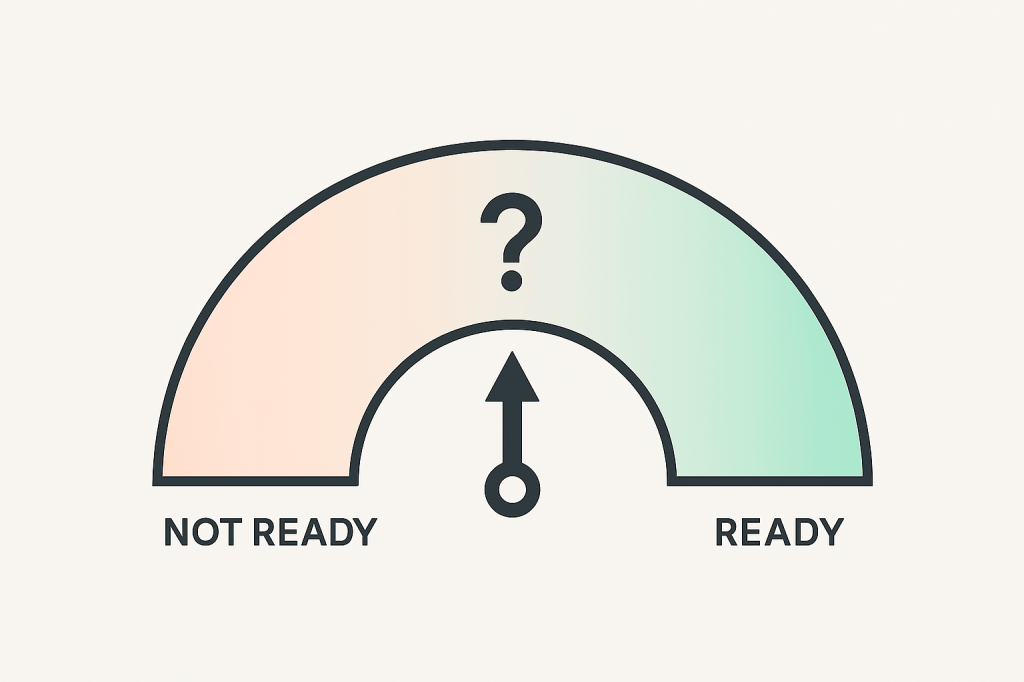
“Ready” is one of those words that can mean almost anything. One of the challenges with this is that achieving shared meaning is not always going to be easy, especially if there hasn’t been any effort put into defining the term when the team started work…
Think about this: You are working on a project and the deadline is approaching for a major part of the project to be completed and submitted. The deadline is non-negotiable Every member of the team has contributed towards co-creating the work that is to be submitted. Somebody says it’s absolutely ready for submission. Somebody else says it’s definitely not ready to submit. Two members say they aren’t sure if it’s ready to submit or not. Who’s right?
If this discussion is only just happening now the deadline is close at hand, my first question has to be about why it has taken so long for this conversation to be had. My next questions have to be about what evidence indicates readiness, and whether that evidence is all there. If it’s not all there, I would also be questioning what progress monitoring was happening and what actions, if any, happened as a result of that monitoring. If additional resources or other help were required, I would wan t to know what was done to obtain those, and what happened as a result.
If something isn’t ready, or isn’t going to be ready, the signs don’t generally leave it to the last minute to reveal themselves. That means some brave questions as part of a an equally brave conversation – not to apportion blame, but to use the situation as a Learning Moment to improve future decision-making about task readiness.
What if the problem isn’t with the process, though? Imagine a situation where all the available evidence shows that the completed work matches or exceeds every specification that was agreed for it. Now visualise one member stating that the work isn’t ready for submission and that they are going to take it on themselves to do additional work – without reference back to the others – to make further improvements ahead of submission.
The team still `owns` the work in their collective name, and that one person who refused to accept `readiness` has effectively stripped the others of ownership but not of accountability in the eyes of whoever the work is being submitted to. The problem is that people are now accountable for things they didn’t do, haven’t seen in their final form ahead of submission, but are still expected to be able to defend.
Leaving aside the obvious content-based issues, this situation will also lead to trust issues, especially if the right questions are being asked but the answers aren’t stopping this behaviour happening. An important part of trust is people being `in the loop` rather than being deliberately excluded from it. Once exclusion starts happening you are heading in the direction of being a group instead of a team.
Remember this: being part of a project team isn’t about one person’s ego above all others. It’s about collective achievement; not about unilaterally deciding everybody else is wrong and deliberately disenfranchising them. Readiness means walking the talk of your Standard Operating Procedures all the way through the project life cycle, rather than ignoring them at the end. It’s about being who you said you are and doing what you have committed to; and being ready to move on to the next task rather than being stuck in the current one for longer than you need to be.
28.10.25
QUICKLY

Your team has a task. It’s important in the overall context of the project. Now it’s been delegated to you (whether because you are the person with the most relevant knowledge and experience, or because you have more time that can be easily allocated to it than anybody else in the team). It’s been impressed upon you that this needs to be done quickly.
Trigger Warning: “Quickly” is one of those words that can create more problems for you than it solves if you don’t take action to clarify what the person delegating the task to you thinks it means in the context of your project and your team.
There are several things that can happen at this point:
- You can nod your head enthusiastically and give the expected answer: “Yes, I know what I need to do and I can get onto this straight away.” Unless each part of this statement is true, I would recommend you do the following –
- You can ask some questions:
- What does |quickly” actually mean in this context?
- What EXACTLY is it you need me to do, by when, and what is my result to look like when I’m finished?
The problem with not asking the questions – as obvious as they might seem now you are reading them here – is that assumptions are made. At best, these may be based on your lived experience. At worst, they may be based on what you think the person giving the instruction thinks (but without asking yourself how you know that).
If you are bothered about asking the obvious questions, let me share this with you. These questions are a sign of strength rather than of weakness. They are a sign that somebody is thinking about the potential answers to the six classic questions: Who, What, When, Where, Why, and How, and wants to have those answers in place so they can make a commitment they are capable of keeping.
Let me share something else with you. I’ve been around enough projects and enough teams now that I want the question-askers, rather than the assumption-makers on my team. If I’ve made assumptions about what other people know and will understand, I need the question-askers to bring me back to reality, because I can serve my team members a lot more effectively if I clearly understand what they need from me if I’m not making assumptions.
Unless you are in a situation where the time taken to ask and answer questions is likely to be life-threatening because it gets in the way of quick action, I would argue for asking questions being a default way of operating.
20.10.25
Quality – a misunderstood word

If there’s a word that has a big reputation for being misunderstood and leading to disagreements (or worse) within project teams, it’s “Quality.”
I’ve seen it so many times – team members all saying the expected words that they want to do quality work, and then the disagreements coming because one or more of them has apparently not correctly translated that commitment into action. That’s when the blame game starts – the one that’s so easy to play. The one that doesn’t involve honestly going back to discover the root cause of the problem and dealing with that to minimise or eliminate the possibility of the same issuer happening again with other parts of the project.
I remember the first real project team I was part of. We very clearly mentioned “Quality” in our Standard Operating Procedures, and we were all convinced that word had a mutually understood meaning. Three of us did things and delivered outputs that reflected a shared understanding, and the fourth did not. The more we tried to bring him on board with what we expected, the further away his performance and outputs actually got.
Looking back – and this is something I should have seen at the time (27 years ago now) – we focused on the outputs at the expense of the process. We assumed the fourth member knew the process and was choosing not to use it. We assumed that he had the confidence to ask for help if that wasn’t true, because that’s what we did. We assumed that he processed information the same way we did, because he always said “Yes” when we asked questions that were more closed than open.
What we should have thought about a lot more, and what should have influenced our actions, is knowing each other better as individuals. Had we done that, I believe we could have come to understand how he processed information compared to how we did and adjusted how we tried to help him. Instead of focusing on what we thought he wasn’t doing well, we could have focused on what he was truly capable of and how we could adjust our team processes to help him be the star he deserved to be.
If the customer is the one defining “Quality” we succeeded because we delivered more than what was originally negotiated. “Quality” is about more than the tangible deliverables for a project. It’s also about the ways we treat each other in our team. It’s about how we come to know each other as people, how we treat each other, and what we are prepared to do to make sure we don’t leave anybody behind.
To clarify a key understanding about the word “Quality”: It is who we are and how we are, not just the tangibles we deliver at the end of a project. It’s the real actions taken by real people doing real things with other real people. It’s about more than stated intent; it’s about commitments in action with and for each other.
8.10.25
Passion – with a caution
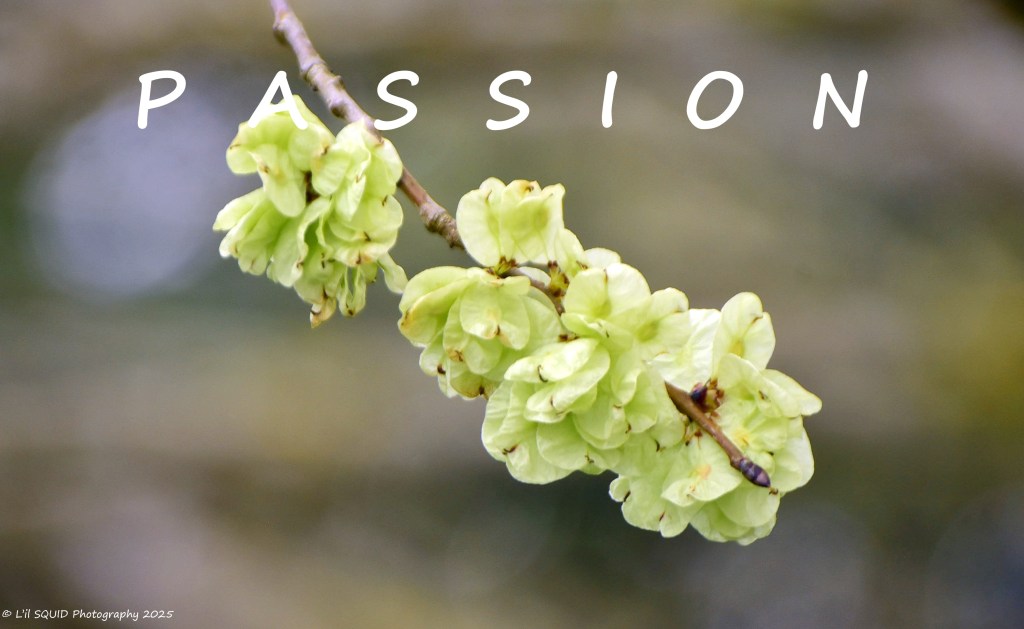
How many times have you seen an advertisement for a position where it talks about having a passion for whatever the job is…? How many times have you been told that when you find something you are passionate about you will never have to work a day in your life? It seems that passion is a desirable (no pun intended) thing to have.
There’s a flip side to this. That’s the point where passion for being involved in a certain type of project, or for carrying out particular tasks as well as you can (which probably translates as “Better than anybody else in the team”) becomes so consuming that it displaces everything else in your life.
You’ve probably also heard it said that you should maintain your work-life balance. That’s one of those statements you could interpret to mean anything you wanted it to mean. You need to be honest when you check in on your balance – when your passion impacts the commitments you’ve made to others; that’s the time to question whether your passion is becoming an obsession.
I’ve seen teams come together that have a high level of collective passion right from the start, even before a project has been fully scoped. I’ve seen teams develop that passion more gradually over a project’s life, as well as teams that never seem to achieve passion for their projects. Equally, I’ve seen teams where passion for the project reaches a level where hardly anything else in life exists for one or more members until the project is finished.
These last teams are the ones where my caution comes in – whether you are the member giving their everything to the project, or anybody else who is being frozen out of that member’s life for the project. I ask you this: Is this project really a `hill worth dying for` – something that is more important than life itself? If you work yourself to a standstill, who will thank you or remember you when you are gone? Work yourself to a standstill and you may not even see the end of the thing that you allowed to become your whole life. All that work and you don’t find out what the project delivered in real life…
If you are watching that passionate team member `from the outside`, I would argue that you’ve got an obligation to them as an individual, as well as to the team, to share a message they may not want to receive: “Take time out to smell the sunshine. You are more than this project, and it deserves the best of you – something it’s not going to get if you don’t take the time to breathe and rest. The other people you support, who care for you – and not just in this project team – they aren’t going to get the best of you either if you don’t stop and smell the sunshine. Do yourself a favour and don’t let you passion burn you out – you matter too much to let that happen.”
The image I’ve selected this week is one that I created a couple of days ago on my birthday. I’ve chosen it because it represents a passion of mine outside all things connected with collaboration and Collaborative Team-Based Project Learning. It’s my mental health/balancing passion – the one that keeps my work passion within manageable boundaries.
What’s your mental health/balancing passion?
29.9.25
PATIENCE
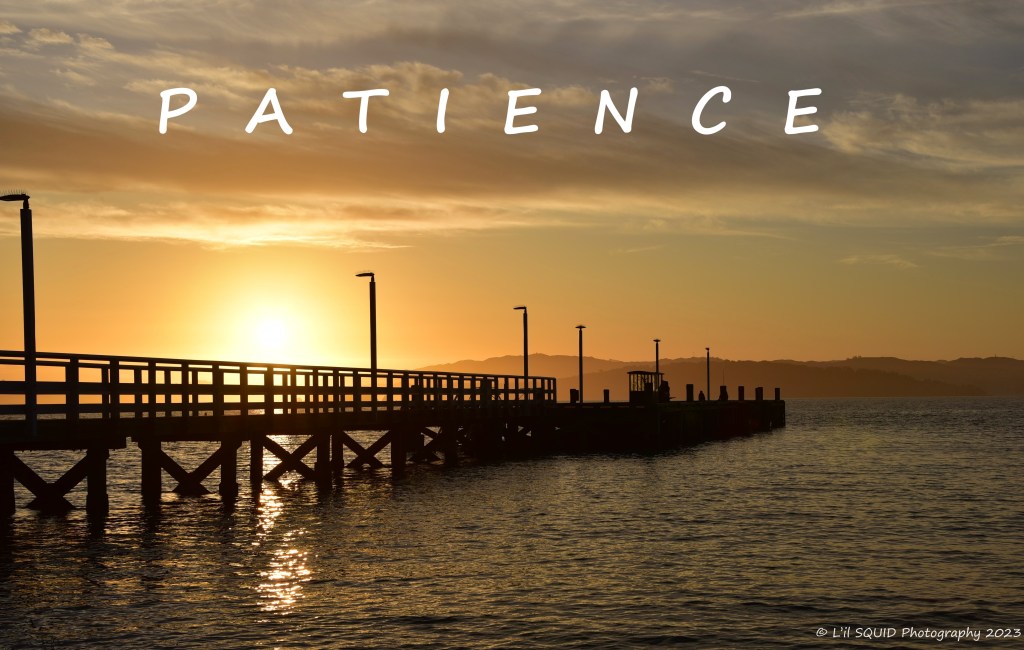
Have you ever been part of a project team where you’ve been told to do more, do it better, and especially to do it faster? Have you been the person in your team who’s been telling somebody else this is what they need to do? Either way, the pressure that goes with these instructions – maybe even orders – can lead to more focus on the need for speed than the need for getting a task or a relationship right.
How much time then needs investing in putting things right because patience was in short supply?
I’m not saying that there won’t be times when a quick decision is the appropriate course of action, because I’ve been around long enough to know those times will exist.
Maybe there’s more information needed to make the best possible decision and it’s going to take time to get that. Not everybody will process the same information at the same speed. Maybe one of more team members will be working in a language which isn’t their first language, and some words or phrases don’t translate exactly between different languages.
Patience – not putting yourself or others under real or imagined pressure to make a fast decision when it’s not necessary will likely lead to better decisions. When I talk about patience, I’m not meaning that all sense of urgency should disappear. Your project won’t have an infinite timeline, so there will be a need for some speed – working out what the appropriate balance of speed and patience needs to be is a great opportunity to work and plan collaboratively.
Time for patience is also a great opportunity to enjoy some self-care. Nobody is a machine, so take advantage of the chance to smell the sunshine. Come back to the task after your break – a fresh mind is always going to outperform an impatient one.
23.9.25
Please – the opener of doors…

Just six letters. The most under-rated word in my experience of project work – and this doesn’t only apply to students learning the formal aspects of project management for the first time – is “Please.” It can be as though this word wasn’t loaded as part of the vocabulary necessary for successful collaboration.
Without it, words intended as requests can assume the force of orders (and not very polite ones, at that). What matters in this situation is less what you intended communicating and more the message as it was received. A message perceived as impolite is likely to generate an impolite (at best) response – and suddenly time and emotional energy are being invested in a conflict that was neither intentional nor needs to exist.
Maybe not all team members share the same cultural expectations around the use of this word. That’s definitely a conversation worth having when you are working out how you are going to work together on the project. A few minutes at the start can save a lot of unnecessary grief later on. When treating people with respect is simply the way you do things in your team, that respect can open doors to a performance mindset, individually and collectively, that simply isn’t possible to achieve by other means.
There might be times when an order without a “please” attached to it is more appropriate than a request –that will depend on the context of the project and the consequences attached to a decision or an action. As a generalisation, however, saying “please” can open doors that would otherwise remain closed.
9.9.25
Perfect (Part 2) – Near enough is good enough…

Following on from my previous post, in which I thought about what “Perfect” means and why we can be so obsessed with achieving it (assuming we’ve managed to successfully define it first), it’s also worth thinking about the “anti-perfect” – the “Near enough is good enough” approach. This one can cause all sorts of disagreements in a team.
The disagreements come back to the questions of who decides what “perfect” is like, who decides what is really necessary as an output (as opposed to what is desired), what resources are available, and what constraints the team has to operate within when trying to solve the problem or take advantage of the opportunity.
Something else that goes into the decision is whether “Near enough is good enough” means that a project output meets all of the specifications the client needs without significantly exceeding any of them, or that it’s OK to meet some of them and miss on others. This week I’m going to look at meeting all the specifications; next week it will be the case of meeting only some of them. Either way, the team and the client need to have the brave and open conversations about what those things mean, then agree and document the decisions reached, because those are what progress and outputs will be measured against.
I remember one particular project where these things had been done, but the team leader decided “Near enough is good enough” wasn’t going to be good enough even if all of the client specifications were met. It was going to be possible to exceed all client specifications by a considerable margin, because that’s the only standard of work that they would be prepared to put their name to. If team members felt unable to achieve this with their parts of the project they should send all of their work to the leader who would then modify it as necessary -= no matter how many extra hours they had to put into it — because that would lead to a standard of output the client should be able to expect. It was not their fault that the client had set their specifications too low…because they knew what the client wanted better than the client did…
Plenty of grief within the team, members washing their hands of their parts once they had achieved the specifications that were agreed upon originally, and a team leader who turned themselves into a martyr to produce what they thought the project should have required. A client who didn’t get any additional benefits from having all the specifications exceeded, because they knew what specifications would best meet the needs of their clients – the project was simply about finding the best way to deliver on the specifications.
In this case, a “Near enough is good enough” result really would have been good enough. A team of really competent people fell apart because the leader wouldn’t accept what they had agreed to in the first place, refused to listen to any other views, and placed too much trust in their own ego. The problems in this situation could have been avoided, because the answers lay in their documentation – specifically, their project contract and their Standard Operating Procedures. Had they simply followed those they could have produced acceptable outputs. Delivering more than was required meant resources not being used wisely, members experiencing avoidable disharmony, and the team’s client getting something where the difference from the original specifications ended up making no difference to their clients.
Doing more than is required doesn’t always mean doing better.
19.8.25
Perfect

Take a look at the image I’ve used to illustrate this week’s thought. What would it take for you to label it as “Perfect”? Petals evenly spaced, with no odd gaps between them? Even focus on all parts of the flower? No pollen spots on any of the petals? Bigger or smaller raindrops on the petals, or no raindrops at all? Monochrome instead of full colour? Here’s another option: Why can’t it be “Perfect” because of how it makes you feel when you see it, without having to analyse its details?
How many times have you heard somebody in a team say that a deliverable needs to be “Perfect”? Whether it’s because that’s what they think, that’s what the team set somehow as its target, or the project sponsor or customer told them needed to happen is less important than the use of the word “Perfect.”
The problem I have with this word is that too often its meaning is based on assumptions, on questions that should be asked and aren’t, on answers that are vague rather than specific. Some team members might feel like they have to keep going on a task until “Perfect” has been achieved (in their eyes, at least) – even if that’s beyond what whoever is on the receiving end of the deliverable actually needs Others may be scared by it because they don’t know what it means, but they are convinced it is beyond their ability (for whatever reasons) to achieve – and saying that scares them more than the consequences of not saying it.
Yes, there are times when I agree that perfection is a useful standard to define and to aim for. If I’m taking medication, I want everything that’s gone into the planning and production to be as consistently close to perfection as possible so I can have confidence it will act as intended to address my symptoms every time I take it. If I’m buying a takeaway sandwich, I’m probably going to accept a degree of inconsistency, justifying it on the basis that the sandwich isn’t likely to be life-altering in the same way the medication is, but it can still take care of my hunger just as effectively despite any slight inconsistency compared to the last one I purchased..
The point I want to make here is that if that word is being used in your team, you need to:
- Agree on the shared meaning it holds within the team.
- Clearly specify what actions and deliverables will demonstrate its achievement.
- Be consistent in its application.
There’s an old saying to the effect that you should always aim for the stars. Even if you fall short of “Perfect” you can still achieve excellence, and that puts you in a great space.
You don’t need to be afraid of the word. You just need to be clear about what it means in the context in which you are using it, and whether it represents the appropriate target to be aiming for.
11.8.25
Bridging the gap: Finding common ground in a team
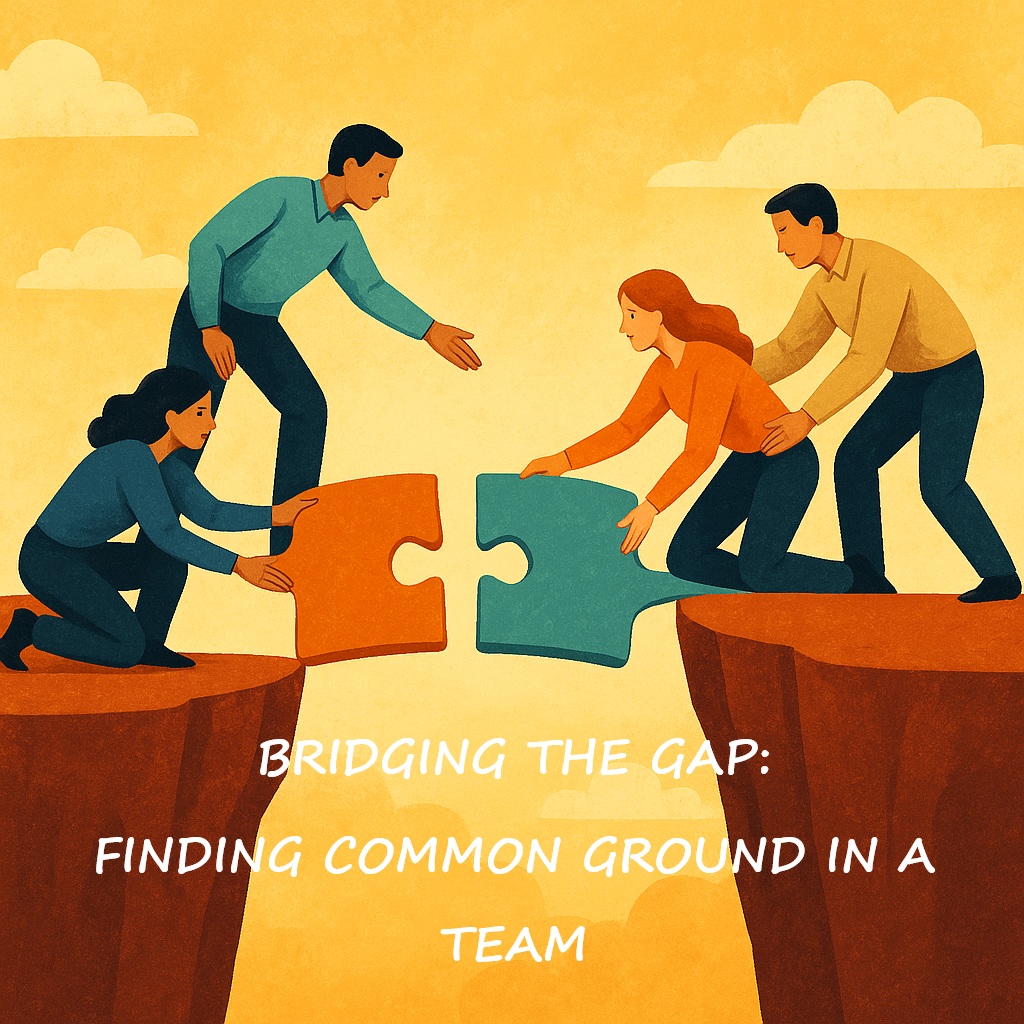
This week I’m sharing some guest thinking. It’s courtesy of my very good friend and collaborator Indigo Jones. She’s been thinking about the challenge of getting a team to the point where its members agree on more than they disagree about.
In any team, be it a corporate department, a volunteer group, or a sports club, a diverse set of individuals come together with unique perspectives, experiences, and goals. This diversity is a major strength, bringing a wealth of ideas and innovation. However, it can also be a source of friction, leading to misunderstandings, disagreements, and a lack of cohesion. The key to navigating this challenge is to actively seek and build common ground.
Common ground isn’t about everyone thinking alike; that would be boring and counterproductive. It’s about discovering the shared values, objectives, and beliefs that unite the team, despite their differences. It’s the foundation upon which trust, respect, and effective collaboration are built. So, how do you find this elusive common ground? It starts with intentional effort and a shift in mindset.
1. Start with the “Why” Before diving into the “what” and “how,” take a step back and revisit the team’s core purpose. Why are you all here? What is the ultimate goal you’re trying to achieve together? Whether it’s launching a new product, organising a community event, or winning a championship, this shared purpose is the most powerful unifying force. Make the team’s mission and vision a constant reference point. When disagreements arise, bring the conversation back to the overarching goal. Ask questions like, “Which approach best serves our mission?” or “How does this decision align with our shared vision?” This helps to reframe the discussion from a personal conflict to a collaborative effort to achieve a common objective.
2. Listen to Understand, Not to Respond. One of the biggest barriers to finding common ground is the tendency to listen with the intent to formulate a rebuttal rather than to truly understand the other person’s perspective. Active listening is a skill that takes practice. When a teammate is speaking, put aside your own agenda for a moment. Pay attention not just to their words, but also to the emotions and values behind them. Ask clarifying questions like, “What I hear you saying is… Is that correct?” or “Could you tell me more about why that’s important to you?” This validates their perspective and shows that you value their contribution, even if you don’t fully agree with it.
3. Identify Shared Values While your backgrounds and beliefs may differ, you likely share a set of core professional values. Do you all value integrity, innovation, or a commitment to quality? These shared values are powerful touchstones. For example, if a team is debating two different marketing strategies, and they’ve identified “creativity” as a shared value, the conversation can shift from “My idea is better” to “Which of these strategies is more creative and will resonate more with our audience?” This common value provides a neutral framework for evaluating ideas and making decisions.
4. Find the “Tiny Agreements” Sometimes, finding a huge area of common ground can feel overwhelming. Start small. Look for “tiny agreements” within a larger disagreement. For example, if two team members are arguing about the best way to handle a project deadline, they may still agree on the importance of delivering a high-quality product. Acknowledge these small areas of consensus. “Okay, we both agree that quality is paramount. Now, let’s talk about how we can ensure that while also meeting the deadline.” This process builds momentum and makes the larger disagreement seem more manageable.
5. Celebrate Diversity as a Strength Common ground is not about erasing differences; it’s about leveraging them. Once you’ve established a foundation of shared purpose and values, you can begin to see differences not as obstacles, but as opportunities. A team with diverse skills and perspectives is far more resilient and innovative than a homogenous one. Celebrate the unique contributions that each team member brings. Encourage open debate and discussion, knowing that a healthy exchange of ideas, grounded in mutual respect, leads to better outcomes. In conclusion, finding common ground is an ongoing practice, not a one-time event. It requires patience, empathy, and a commitment to seeing the bigger picture. By focusing on shared purpose, practicing active listening, and celebrating diversity, you can transform a group of individuals into a cohesive, high-performing team that is far greater than the sum of its parts.
4.8.25
Only

Take a look at the image I’ve chosen to accompany this week’s thought.
It’s only a wave…Waves happen at sea all the time. Approximately a 2-metre swell (give or take a little bit), in this case. Maybe it’s nothing much to worry about – if you’re on a large ocean-going vessel in the middle of the open ocean. If you’re on a 6-metre power boat a hundred metres off the rocky shore where I created this image, you might be a bit more worried if you see this bearing down on you. Whichever scenario is true, it’s still only a wave, but how you respond to in is likely to be quite different, depending on your circumstances
Only is one of those ambiguous words that doesn’t always mean what people might expect it to mean. I’ve known some team members to be deeply suspicious of this word – a suspicion I have sometimes had myself, depending on who has been using the word with me and the context in which it is being done, and what previous experiences involving this word have been like.
It might mean that there is a small as opposed to large amount of work to be done on a task, or a short rather than long time available to do it. Perhaps the task requires somebody going outside their current comfort or experience zone, but by a small amount rather than a large amount. Of course, issues here are who is defining what is only a small amount compared to a large one, and the criteria they are using. If those criteria aren’t clearly specified – meaning they can’t be examined for relevance or appropriateness – I think it’s right to be and remain suspicious of them until clarification and acceptance are achieved.
The amount of time team members are prepared to invest in arguing about the real meaning of only – before a task has been started, while it’s in progress, after it’ finished, or all three, can end up becoming bigger than the thing that needed doing in the first place. If you want to avoid a scenario like this, think carefully about the meaning you are applying to the word versus the meaning the person on the receiving end of it might be applying. Be clear before you use the word so you can explain exactly what you are thinking, and you can adjust your thinking, if necessary, before anybody needs to commit to anything. The effectiveness of your thinking might be the difference between an emotional tidal wave of Poseidon Adventure-proportions or a relatively small ripple that’s much easier to navigate.
22.7.25

Never
A word I’ve often heard in the project team environment is “Never.” It I’m being honest, I must admit to saying it a few times myself when I probably should have been thinking more positively and inquisitively.
Sometimes it’s used as a statement of fact. Other times it’s used as an opinion disguised as a fact. Sometimes it’s just a straight-out refusal to do something that doesn’t have a fact or an obvious opinion behind it. It might even be a brave statement that validates (in a secret way) what somebody else in the team didn’t have the courage to say out loud, but they can take courage in lining up behind it now somebody else has said it for them.
There’s another way to think about this word: As a Learning Moment. That learning comes from the question it should encourage you to ask: Why? A question intended not as a challenge, or a statement of wrongness, but as the opening of an opportunity to know what lies behind the word. Ask the question, pay respectful and critical attention to the answer, and engage in the conversation. You might just have opened up an opportunity that wouldn’t have been discovered otherwise.
15.7.25
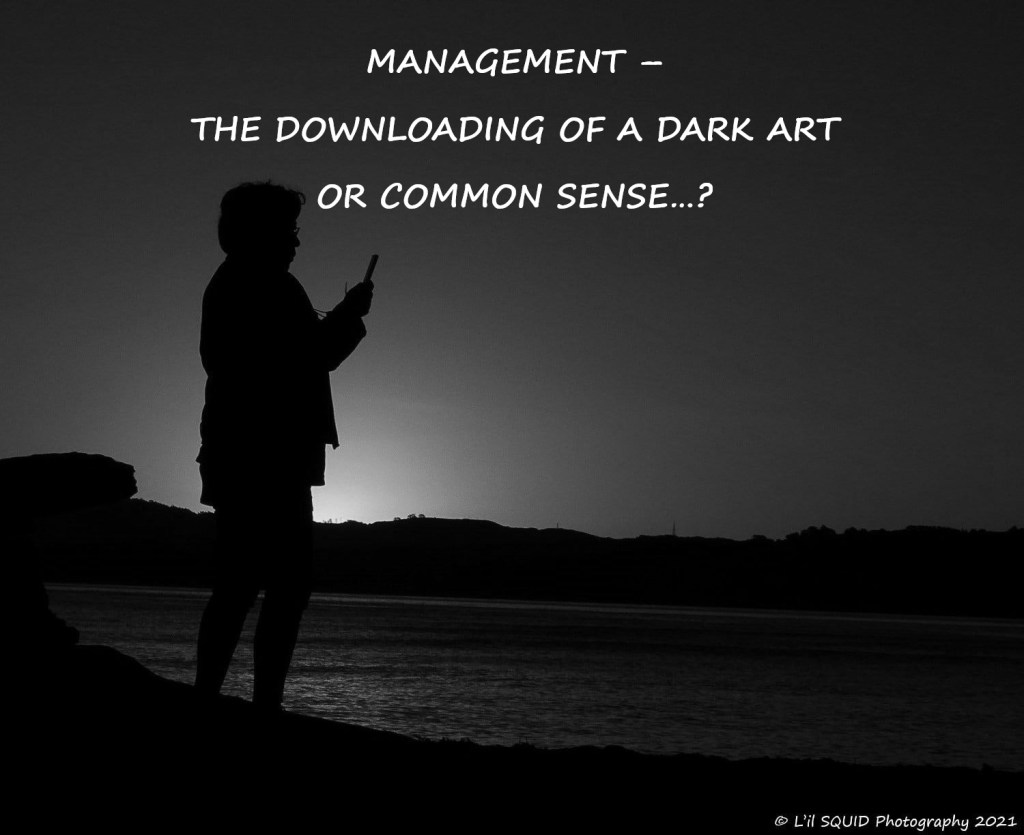
MANAGEMENT – THE DOWNLOADING OF A DARK ART OR COMMON SENSE…?
Every enterprise, every project, every team – needs management. Is it some dark art, the details of which are downloaded at sunset by the only person in the team who pretends they understand what’s meant to happen, and who then tells everybody else what to do?
There has been plenty published about what it is – and what it is not. From the ancient holy books of various religions, right through so- called `gurus` of various schools of thought whose thinking is studied in business schools, there is so much thinking available about what management might be.
Having said that, there is one misconception I come across far too often, especially when working with teams of students engaging in their first serious collaborative project-based learning experience: That management is something done by people called “Manager” or some similar title. They tell people what to do, expect it to be done, and get grumpy if it isn’t. On their own, these things have some truth to them (a pity about that last one).
The misconception is problematic, however, when it is accompanied by a belief that managers are the only people in the team who `do` management. Putting all the decisions about Planning Organising, Leading, and Controlling onto one person risks overloading them with things that they are primarily responsible for doing, as well as escaping any responsibility for people who don’t have the `right` formal title.
There is no reason that everyone in the team should not practice self-management. Being part of a project or a team is not all about getting a free ride. It is about working collaboratively towards a shared end result. The reality is that not every member of the team will want to have a formal manager’s role, either in this project or later projects – that’s just not them. If they are able to practice self-management, though, that means they are capable of more effectively supporting the formal manager to do what they need to do by being in the right place at the right time, doing the right things in the right ways.
It might mean the formal manager needs to do some coaching to help their team members learn to self-manage effectively. It definitely means they need to support their team members self-managing, to help them create Learning Moments rather than Punishment Opportunities. Management does not mean – or should not mean – that somebody winning means somebody else losing. Effective collaboration, well managed, is all about creating situations – a culture, in fact – where everybody on the team can win things that are important tom them.
8.7.25
Minimalism

How much is enough? How little is enough?
I can pretty much guarantee somebody in a project team is going to ask these questions. There is a certain logic to them – the team has a Minimum Viable Product that it needs to deliver, and there must surely come a point at which you’ve done more than you can be rewarded for While some team members may be thinking about the answers in terms of what the team must do, they will all be thinking about the answers in personal; terms, because that’s how we experience things.
Think about this: If a member is being told they haven’t done enough with their part of the work – a not-uncommon scenario – what things are they likely to say in response?
- The meaning of what I’ve done is perfectly clear.
- Who says it’s not enough?
- What standard is my work being judged against?
- All I did was strip out the `fluff` – the must-know information is all there
- If you want more, what more is it you want – and why didn’t you make that clear in the first place before I started the work?
- I don’t have the time or resources to do more than I’ve done.
- Why are you wanting to do more than what we’ve been asked for?
- There’s no point in adding more to what I’ve already done because it’s not going to add anything worth having to what we are delivering.
Maybe the real problem here is not minimalism of the output, or a member trying to get away with making a less-than-reasonable contribution to the team effort Maybe the problem is minimalism of the communication that set the work up – making assumptions about what members would know without it being explicitly stated.
To decide if there is excessive minimalism in the output, first you should challenge potential minimalism in the foundational input.
1.7.25

Magic
It’s a word you might not hear that often when it comes to project teams, and you might doubt it’s meaning when you do hear or see it used. Maybe you conjure up images of mysterious things happening by the light of the moon, of witches and wizards, and all sorts of supernatural beings…
Who am I to say none of those things might be involved? I simply want to say that magic things can happen a lot closer to home, and that there’s not always much mystery about what makes them possible:
- Come into the team situation with an open mind and an open heart. Just because everybody on your team is different to you doesn’t make anybody `right` or `wrong` – it simply makes them different. That difference is where the magic comes from, because different ways of thinking about the same problems or opportunities usually end up with better solutions.
- Be prepared to experience the magic of a relationship that just works – but never take it for granted. You still need to keep that open mind and open heart. If you are prepared to keep investing in the magic possibility, you shouldn’t be surprised when the magic starts to happen. It won’t have a scheduled start date and time – it will just happen, so stay alert for when things begin to change, because the changes might be quite small at first
There are also teams that you wouldn’t put together if you looked at the members on paper – they don’t have anything much in common. Two of the best teams I’ve ever been part of fitted this description. One of them was deliberately put together by a manager who was a lot more visionary than he was given credit for by most people. The other came together because we found we had similar work ethics and cared about similar things.
Each of us was there for the others when the going got tough. Sometimes that simply meant listening while somebody sounded off; other times it meant deliberately collaborating to solve problems or take advantage of opportunities. We were the most unlikely matches on paper – yet the relationships worked – as if by magic.
Be your authentic magic self, do magic, and magic will find you in return.
25.6.25

Leadership Lesson 3 – Dealing with life in the spotlight and bringing peace
Following on from my previous thought, this week I’m thinking about dealing with life in the uncomfortable spotlight. To put it another way, it’s about finding (or becoming) that beacon of peace in what can feel like a hostile jungle of darkness. I don’t pretend to know all the answers – often they depend on the circumstances of the moment – but I’m going to share stories of a few I’ve been associated with as learners work their way through collaborative projects, and the lessons I’ve taken away from them.
- If it’s true that a leader is only as good as their followers allow them to be, a Contest of Mutual Destruction is a pretty pointless exercise – but I’ve seen it happen. A leader gets it into their head that many of the issues they are dealing with have actually been caused by one specific follower. They make it their mission in life to undermine that follower quite openly at every possible opportunity. The follower either `quiet quits` or actively and openly retaliates against the leader. There are no winners in this contest, but a team-full of losers is easily achievable. If your team has a process for dispute resolution, this is the time to use it. The longer the situation remains unresolved, the more people are going to trap themselves into positions where they feel like they have too much `face` to lose if they compromise. Sometimes it takes the moderating influence of a third party to help people start focusing on the issues instead of the personalities, and start bringing peace.
- Believe it or not, the leader (the person with the formal title) doesn’t have to make all the decisions on their own. I’ve seen teams where followers have regarded any attempt to share leadership as a trick to minimise the amount of trouble the leader ends up in when something the team does goes wrong. To be fair, there have been a few teams where that’s probably not far from the truth but, for most of the others, it’s been a genuine attempt by the leader to share ownership and agency. The way around this moment under the uncomfortable spotlight is to have an open conversation that addresses six critical questions: Who, What, When, Where, Why, and How. This can lead to a more nuanced and negotiated sharing of leadership and development of those skills that bring the peace of intention across the team.
- Some leaders will choose to walk away. I’ve worked alongside a couple of really great leaders in the past who did exactly that. It’s not because they no longer believed in what they were doing, or didn’t care as much for their duty of service to others. In both cases, the attacks on them were horrible, sustained (in my view, baselessly), and incredibly personal. Those leaders chose – for once – to put themselves first and to care for their own physical and mental safety. They recognised that dying for the role wasn’t going to do anybody any favours, and they made the incredibly selfish (in a good way) decision to step out of the spotlight. Instinctively they understood that, to lead others, first they needed to have the personal peace to be able to lead themselves.
I’ve only looked at three examples here, and two of those probably represent extremes on a continuum. I’ve deliberately chosen those because I think there is much to be learned from them. `
- In the first scenario `common sense` suggests that using the already existing dispute resolution procedure is the way to go, because it can help redirect the emotional energy away from personal attacks and self-justification towards more collaborative thinking and behaviours. This particular situation I’m thinking of is one of the few times I’ve stepped into a project team’s issues without being invited first, because I could see the effect the escalating situation was having on the people involved. Yes, I could have justified it by telling my boss that members of this team insisted on discovering painful ways of meeting some of the course learning outcomes, but the intensity of what I observed meant that my duty of care towards these people in my charge overrode the possibility of that approach for me. Members were guided to discover and own their own solutions, nobody was undermined, the team made it to the end of the project, delivered most of what they had contracted with the Project Sponsor for, and all learners took away some valuable deep wisdom.
- In the second scenario If you only have a small team, chances are every team member is going to be taking the lead on more than one aspect of the project. That doesn’t mean each member having the same number of leader roles, because some tasks may require a lot more work than others. It’s better to look at the amount of work involved when trying to decide if workload is appropriately allocated, or if changes need to be made. Even if it’s what members claim to want or be happy with, over-allocating or under-allocating work is probably not going to produce the desired results except (maybe) in the short term. This means the need for reasoned conversations where the workload is explored, compared with the Knowledge, Skills, Abilities, and ATTITUDEs (KSAA) of team members. Team members could have the opportunities to both play to their existing strengths as well as developing new strengt5hs as they work towards their shared vision – it’s amazing what a little open-minded exploration and sharing can make possible.
- In the third scenario I’ve seen that decision misunderstood more often than it’s understood. It’s been called `selfish` in a bad way because now it means that somebody else has to step up and take on that role, and nobody else in the team felt ready or willing to do that. Whether they step away from the leadership role, or choose to step away from the team, project, or even the whole course at this time, their decision probably has a mix of peace and regret attached to it, so I make sure I’m still supportive of them and checking in on their welfare. For the rest of the team, it’s time to go into deep support and coaching modes because there are still some issues that need dealing with here. Unless the leadership void is filled the team will probably self-destruct. Even if the void is filled, there still all the thinking and behaviour that led to the vacancy existing in the first place, because what happened to one person can easily happen to another if I don’t initiate the conversations that will help people figure out what happened and what they can do to change how the future plays out. Those are not easy conversations, or entered into lightly, but me taking the easy way out isn’t going to help team members develop effective leadership and followership skillsets that will go with them beyond the end of the current team and project situations.
Resolving each scenario depends on the willingness to initiate and work through brave conversations. Even though life in the spotlight might not always be for enjoyable (or even fair) reasons, how brightly it shines and what it ends up shining on are things that a leader can control. The scenarios described here are all ones that were resolved with varying degrees of success and satisfaction because I wasn’t prepared to allow the negative spotlight to outshine the positive spotlight. That’s an important commitment for anybody in a leadership role to make and, having made it, it’s equally important to stick with it because that’s what your people deserve, and that’s where the peace underpinning awesomeness comes from
9.6.25
Leadership Lesson 2 – Life in the spotlight

Something that not all leaders may feel comfortable with, especially if it’s their first leadership role, is being in the figurative spotlight. I’ve had experience of plenty of project teams where that spotlight wasn’t necessarily being shone by somebody with good intent. Sometimes it was shone by somebody who really wanted to `have a go` at the leader because they didn’t like the decisions the leader was making. They didn’t have any suggestions for how to do it better – just strong conviction that it wasn’t being done right. All too often, they didn’t want the leadership role for themselves – they just didn’t want that other person to have it.
The spotlight served to illuminate the leader as a target for that person’s dissatisfaction and, if anything wasn’t done to address that quickly, as a rallying point for that person to draw other team members to. The analogy I draw is like kids in a playground disagreement – the one with the most friends somehow `wins`.
The person in the formal leadership role had either stepped into the role voluntarily or competed to get it. That didn’t automatically make them a perfect choice for the role, but it’s usually a pretty good indicator that they have something the role needs, and they are prepared to invest themselves in helping their team form a vision and work out how they are going to collaborate to achieve it.
Maybe some have gone into the leadership role `wearing rose tinted glasses`, with the expectation that everybody on the team is going to `play nicely together`. The reality of humans – and student project teams are no different to work project teams – is that the spotlight isn’t always going to be about celebrating or helping the leader to be the best they can for the team.
Don’t get me wrong – I’ve seen some teams where the leadership experience is almost rainbows-and-unicorns perfect, so it can happen. I’ve always been up front with each new cohort, though, that reaching the rainbows-and-unicorns state takes ongoing effort, and the leader is only going to be as effective as their followers empower them to be. Empowered leaders have no issue sharing the spotlight with their teams.
In my next Thought (I already know what it’s going to be in advance), I will be talking about different ways of dealing with the uncomfortable spotlight.
26.5.25
Leadership Lesson 1 – Leadership isn’t (or shouldn’t be) a popularity contest

The nature of humans is that most of us like to be liked – that’s just how our heads are wired. Thinking back over all the leaders I’ve worked alongside in diverse industries and organisations, the ones I’ve respected the most have been the ones who understood leadership isn’t a popularity contest. They did what they did for us and with us because that was what aligned with the organisation’s vision and mission. They were friendly; but not fixated on being our friends (because these are two completely different ideas). They wanted us to participate in making decisions that affected the work we did. When they had to make decisions we weren’t happy about, because sometimes the needs of the many come ahead of the needs of the one, they wanted us to understand the difference between leadership decisions and friend decisions. Leadership decisions kept us in business, friend decisions might have increased their popularity in the short-term, but with much greater risks in the longer-term.
When I stop to think about it, leaders whose primary focus wasn’t on their personal popularity were more predictable. You knew where you were with them. It didn’t mean they couldn’t take the adventurous decisions when necessary, but they played primarily to the needs of the situation rather than the perceived fancies of their people, never losing sight of the vision and the mission. The integrity they showed in not allowing their own ego to ride over the top of everything else meant they gave us a masterclass in effective leadership, and in what we were capable of every day.
Thinking of how the teams with leaders focused on vision and mission routinely outperformed those where the leaders focused on making popular decisions, some people definitely needed their eyes, ears, and minds more open to the example that was being shared with them, and to think more critically about it.
Leadership isn’t (or shouldn’t be) a popularity contest.
19.5.25
Learning moments

One of the beautiful things – some may see it as a frustrating thing, depending on what their experience was like – about collaborating in teams is that you get to experience learning moments. By that I don’t mean the formal learning or training opportunities that may be associated with a particular project. I mean those unexpected little moments where you learn things about yourself that you wouldn’t have learned if you weren’t working with these people in your team:
- What you care about – for others, and for yourself.
- How deeply you are capable of caring (it may be a lot more than you used to think).
- What you are prepared to do for others, and for yourself (for no other reason than it’s the right thing to do).
- What you are interested in (it may not be what you thought before this team or this project).
- That asking questions is a good way to find things out ( since the only `dumb` question is the one you don’t ask because you don’t want t look `dumb`).
- That something you once thought impossible for you is something you can do (even if you had to create a way of doing it that worked for you, because the outcome is more important than one single process).
- That you can have mutually satisfying personal and professional relationships with people who aren’t carbon copies of you (because difference doesn’t equal `wrongness`).
- That you are an amazing human being (you may not be `everybody’s cup of tea` but it’s better to be an authentic version of you than a poor copy of who you imagine somebody else wants you to be).
Be aware that these moments can happen at any time, and that they are always incredibly valuable. No matter how you do it, make sure you capture them while they are fresh. The longer you leave it, the more easily forgotten or misremembered they are. Make sure you celebrate them – they happened to you for a reason.
12.5.25
KEEP GOING
There will be times when things are tough – I’ve been around enough teams and projects to know this is one of the `laws of the universe`. There will be times when you can’t see the `light at the end of the tunnel` – and giving up seems like your only option. When you don’t just feel lonely, but all alone and wilting, past your best (like this week’s image) – KEEP GOING.
You’ve come too far by this point in your journey not to go further. You’ve done so much that is good (if not awesome) by now not to do more. You are a beautiful human being, and a team member who makes a positive difference, not just to the project but to your team. You matter.
Nobody has the right to try to destroy you, to make you feel wilted. Nobody has the right to take your dreams away just because they aren’t living theirs for reasons that have nothing to do with you.
You may be closer to achieving your dreams than you think. To find out how close, back your own passion and – you guessed it – KEEP GOING… Even if you don’t owe it to anybody else, you owe it to yourself. Somebody (on your team, or in your life outside the team) may see and encourage your wilting. I’ve been on the receiving end of that enough times to know how debilitating and devaluing it feels. KEEP GOING – because you are still beautiful, and capable, making a positive difference, and you matter.

5.5.25
CHECKING IN
After an incredibly busy couple of weeks, I had a call today from a very dear friend whom I haven’t spoken to in a couple of weeks. We’ve messaged a few times, but this was an actual voice to ears and back again conversation. It started off, as such conversations do between us, with the words “Just checking in…” That’s one of the things that makes us an effective team – we check in on each other not because that’s in a set of rules anywhere, but because it’s the right thing to do. We don’t need any other reason.
We might not have a problem of our own that we consciously need to solve. That’s not the purpose of checking in. Instead, it’s about making sure that our fellow team member is doing OK. If they have a problem they need to solve, we can help. Helping doesn’t mean telling them what to do, but a suggestion might be made, or a question might be asked to help them work towards the solution that’s best for them. Sometimes it’s enough for them to know that somebody else has their back and is available and willing to support them as and when necessary.
If your team is separated by distance, a call is a great option. Message if you must, but there’s no substitute for hearing another voice in real time, being able to bounce spontaneous and serendipitous ideas around. If you can meet in person, maybe it’s creating the time to share a cup of tea or coffee, a short stroll in the sunshine and fresh air… Your checking in is sharing a precious gift with that other person (or those other people) in your team. It’s a gift made up of time, recognition, appreciation, celebration, and free thinking. The beautiful thing about this gift is that it’s equally wonderful regardless of whether you are the receiver or the giver.
This week’s image is one I posted in a photographic group I’m an admin for, and then shared on my own Facebook page. The words that went with it were: “For anybody who needs it today – here is a rose.” You might argue that social media’s a global and impersonal way of communicating, but I know some people who’ve seen this will have had a hard day, and if that image brings them a moment or two of pleasure, the checking in’s been a hit one-sided but it’s definitely better than not checking in at all.
Check in today. It’s the human thing to do.

14.4.25
Kindness
Let’s face it – working together in a team can be a stressful experience. Working on a project can be a stressful experience. Stress isn’t necessarily a bad thing, but there is such a thing as bad stress. This week I want to share something with you that can be at least as effective in managing stress levels as developing or upgrading any hard skills, because it brings together many of the soft skills I’ve discussed since I started sharing these thoughts.
Be (in no particular order): generous, helpful, caring about other people, friendly, treating people with respect, considerate, supportive, encouraging, time-sensitive, benevolent – all because you can, and because it’s the right thing to do. Kindness is not primarily about what you can get out of an act of kindness, but about what you can do to help make somebody else’s task or life go a little easier – because you can, and because it’s the right thing to do.
Your first thought isn’t about taking over and doing the task yourself, although they may end up asking for this (in which case, that’s OK). Instead, it’s about being sensitive to all the clues that come from what they are doing and how they are doing it, and acting based on the clues. Offer to help with a task, or to reschedule or reallocate part or all of it. Offer to share your knowledge and skills to help your fellow team members improve their task performance – remembering that formal training isn’t the only way great learning happens. Buy somebody a coffee or a nice snack – the value of the thing is way less important than the deliberate and thoughtful act of giving. Offer up some praise for something that’s being done really well – the fact that you took the time to notice and the time to say something when you didn’t have to are both invaluable.
Practice kindness as a matter of course. My experience is that it’s likely to be repaid when you are having a tough time and could really use a little support. What goes around has a habit of coming around.
If anybody tells you kindness is a sign of weakness on your part as a leader (whether your leadership role is formal or informal), it’s not. It’s a sign of strength. When I look back over a long and varied working life, the leaders I’ve had the most respect for have all been strong (kind), not because anybody told them to, but because they instinctively understood and practiced kindness.

7.4.25
JUST…
This is one of those little “qualifier” words that often finds its way into explanations or instructions, but doesn’t always mean what you think it means. You might be forgiven for thinking that’s all you need to do as your part of a task. It’s possible the person who said it might mean that this is what you need to do to start a task off – but there’s more coming that they will tell you about later (when you least expect it because you think you’ve complete a task, or met the required performance standard).
If you are the person using the word – clarify whether you are using it to refer to only part of a task or performance standard or the whole thing. If there’s more to come, when can the person on the receiving end expect to get the rest of the information they need? Don’t make assumptions about what the other person knows.
If you are the person on the receiving end of the word – clarify whether the other person is using it to refer to only part of a task or performance standard or the whole thing. If there’s more to come, when can you expect to get the rest of the information you need? Don’t make assumptions about that the other person is saying.

31.3.25
Joy
We spend a lot of time, whether it’s in our teams or on our own, doing `serious stuff` at work. We get involved with our project sponsors to work out what they need and what they want – and those two aren’t always that close together. We create plans and try to make them the best we can by engaging in some form of risk management. We create processes and rules and monitor how well they are followed. Somewhere inside all of this, we create, manage, enhance, and sometimes end relationships. We might agonise over the lessons we have to learn from a project that didn’t turn out quite the way expected or celebrate something that went better than expected.
There’s a real danger that lurks among all this `serious stuff` – the one thing that gets overlooked. Joy. When things are getting on top of you, take a few moments to notice something around you that gives you Joy. Joy simply because it’s there in that moment. It’s not about travelling a long distance or spending a large amount of money. It’s about something that already exists without you doing anything other than noticing it Let your sesses focus on the moment and soak it in. You don’t need anybody else’s permission to do this, and you don’t need to involve them in it – this is just for you.
Experience some of the `serious weight` lifting from you. Enjoying this moment of joy is not about making all the seriousness go away, because there’s definitely a purpose to it. Instead, it’s about letting the Joy help restore some balance in your life, because we aren’t designed to be 100% `serious stuff` 100% of the time.
Repeat as necessary.
I always make a point of visiting the Buzzy Bee every time I’m attending a course at Wellington High School. No matter how my week has been until that point (and there’s a lot of `serious stuff` happening right now as I’m finalising my doctoral thesis and the artefacts that go with it), spending some time on Saturday morning with Buzzy Bee was an absolute Joy Refresher for the week ahead.

17.3.25
Judgement – More than black or white
One thing that happens in every team, in every project, is the need for people to make judgements. Facts, figures, opinions, bringing people into the team, exiting people from the team, options, recommendations, actions, reflections – every day, we are making judgements about what do and what not to do, what was done and what could/should have been done.
A common expectation – or is it a misconception – is that judgements should be black or white. Right or wrong. No shades of grey. Do not be taken in by this expectation. Do not feel trapped into making judgements that will be popular or expedient where those are the main criteria driving you. Think about the sorts of judgements that will be morally or legally right. Think about the judgements that will deliver the greatest good for the greatest number. Think in the area between black and white – like this week’s image, there’s a lot of great detail in that space to help you understand the totality of what’s happening.
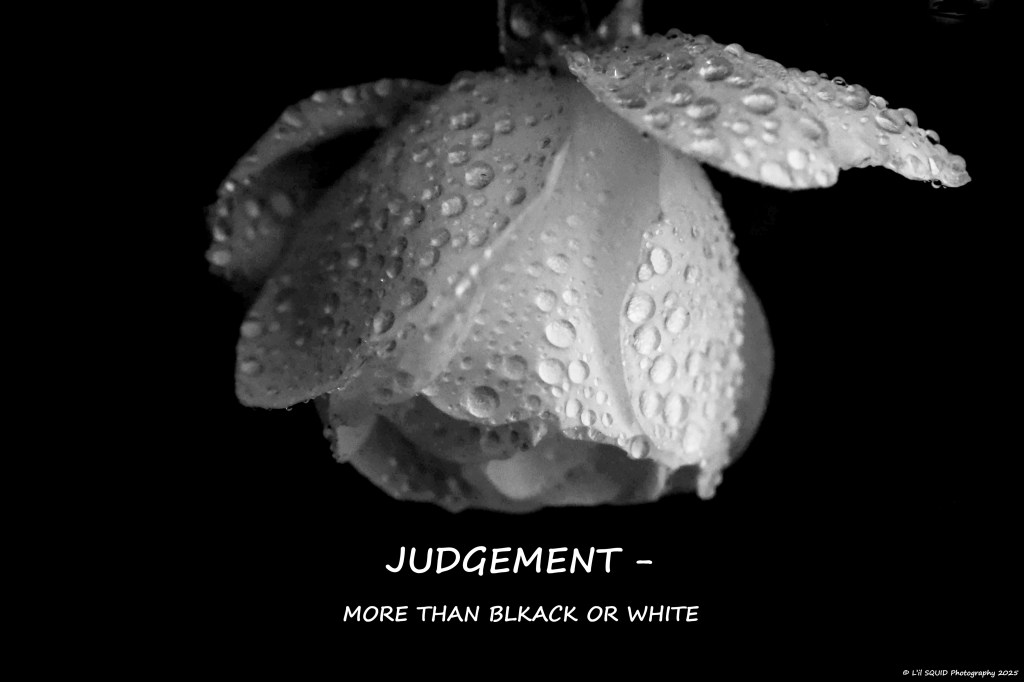
11.3.25
IMMEDIATELY – YEAH, RIGHT
This week’s word is another one where most people think they know exactly what it means – if only they could all agree on what that meaning is… How many times have I been told I need to stop what I’m doing and do something else immediately? Come to that, how many times have I told somebody else to do that? The answer to both questions is plenty…
If you are dealing with a life-threatening situation, I get why you would do that – there might not be time to plan your way through the potential options in a detailed way, together with an obvious negative consequence of not doing something right now… If that’s not the case, it’s worth pausing long enough to think about what else happens if an immediate change in plan takes place. Changing one thing from “when the plan calls for it to be done in the normal course of events” to “immediately” can affect multiple other parts of the project. If you aren’t looking at the project plan when you are saying or writing those words, you should be looking at the up-to-date mental copy you keep of it in your head.
Instead of just issuing the command, why don’t you explain what needs to happen to your team and get them involved in exploring other potential solutions? These are the people who are going to be carrying out the work. They might have information you don’t have – information that would cause you to make a different decision. They are on your team because of their thinking ability, so give them a chance to do it. They might come up with a better solution than “immediately” – the best advice I can offer (from experience) is not to let “immediately” come between you, your team, what is really necessary, and what is actually possible.

3.3.25
Impossible
This has to be one of my all-time favourite words when it comes to teams and collaboration. The one that says not only can something not happen, but also that there won’t be an attempt to make it happen, and that there won’t be any alternative proposed. In other words, it’s a lot of letters strung together to say what two letters could say equally well (maybe even better) – No.
If you’ve used this one, or you’ve been on the receiving end of its use, have you ever stopped to think about how quickly and how strongly it comes out? It’s like that word has been waiting for just this moment in time to do its thing, regardless of the question, instruction, or situation. When it comes out so quickly, you have to wonder what, if any, critical thinking has happened in the background to generate that response. Is it going to be backed up with facts and figures, predictions, opinions – or just repeated over and over again as if the one word on its own is THE answer?
At the very least, this response needs a question – WHY? Nobody in the team will understand where that word came from unless the person who said it or wrote it explains their thinking. Questioning that thinking should not be a way of disrespecting that person; it should be a genuine attempt to arrive at a level of understanding that otherwise doesn’t exist. The answer on its own may not generate agreement that a different strategy needs to be used, but the debate about what that different strategy could be won’t happen without it.
Maybe past experiences are behind the word. Maybe those experiences have led to predictions about what’s likely to happen this time – even though it hasn’t happened yet. Maybe somebody’s overloaded with tasks at the moment but nobody else has noticed, and this is actually a cry for help. Maybe somebody genuinely doesn’t know how to do a particular task – but they don’t know how to explain this without worrying that they will look bad, or to ask for help and support. I know all these things are real, because I’ve lived them, observed them, and heard about them.
Here’s an idea: Change the dialogue. Have the brave conversations necessary to translate Impossible to I (a)m Possible. You will be amazed at what your team can do just by changing this one word.
24.2.25
Important
You know the deal when something’s important – it’s meant to be important for everybody on the team – not just for you or the person telling you about it. That means it doesn’t matter what else you are working on now; or are planning to start working on. This important thing just stepped to the head of the line and everything else got pushed backwards – no matter how important that used to be.
Isn’t it frustrating when other team members don’t `get` how important a task really is…Why does this happen? Probably because they don’t have all the information that they need to understand the meaning that’s being applied to the word in this particular set of circumstances. There are two issues here:
- Assumptions are being made about what people will understand based on information that hasn’t been shared with them.
- Important isn’t a matter for negotiation – it’s a matter for getting things done.
If you need team members to pivot what they are doing, share information instead of making assumptions or issuing commands. If they are lying back looking like they aren’t bothered about anything to do with important – haven’t a care in the world resist the temptation to characterise it as deliberate disobedience or disinterest. Think instead about the information that would help them understand what important means in this case. They will be a lot better placed to play an active part in working out the most effective way to make important happen. Shared understanding and collaborative problem solving are where the magic takes place.

Important – remember: what is really important to you is not necessarily so to me…
18.2.25
HOW – one of the most useful three-letter words ever.
Continuing on with the H words for project teams, this week we have “HOW” – one of the most useful three letter words ever. It recognises that there’s a knowledge gap somewhere. Maybe from seeing another team member doing something and you want to know what it will take for you to be able to do that too, or to do it as well as that person. Maybe it’s something you want to find out that nobody else in the team knows either.
There are two ways to deal with this situation – ask the right questions; or try something to see what happens.
The person who knows how to do what you want to be able to might not know what you don’t know until you ask them or maybe they don’t know that you need to know something from them – until you ask them. Only when they know what the knowledge gap is can they play their part in helping to minimise or eliminate it.
Some cautions with asking the questions. Firstly, you need to make sure that the person you are asking is the right one to give you the answers you need, because a quick and convenient answer isn’t necessarily the same as a right answer. Secondly, you need to make sure that the person on the receiving end of your questions understands them. That means avoiding jargon wherever possible; and maybe having to rephrase the questions to make sure you are operating based on common shared meanings.
If you are the person on the receiving end of the questions, you can point the person in the direction of some appropriate resources, tell them how to do the task, or show them how to do the task. I’ve seen and been on the receiving end of all three approaches, as well as doing all three. To a certain extent, you are making judgement calls about what the person already knows and how they prefer to learn. Remember that you once knew only as much as the person who just asked you how, and you weren’t as fast or instinctive at your task as you are now. Share at a pace the other person can work with, even where that’s not the pace you are comfortable with now. Let them work up to your level, just like you did.
My experience is a that a combination of all three is usually a good way to go, especially if you add in an opportunity for the person to show you what they understand from what you’ve shared. That gives you an opportunity to fill in any gaps, support the person in all the things they are doing right, and correct any wrong approaches before they become bad habits.
Trying something to see what happens is how this week’s image came about. Wanting to achieve a specific outcome with the image of this rose in our garden, I used a Picture Control setting I hadn’t previously used, and the change in that one setting made a big difference in what I needed to do in post-processing. This is something I wouldn’t have appreciated unless I tried the change to see what happened.
One caution with trying something to see what happens: Think about the consequences of not getting the outcome you want. No major issue with my image – I could simply create more images with different settings until I got something I was happy with, and that would only cost me a little time. If there were financial or other significant consequences, I would probably do some more thinking before doing some more trying – it’s a matter of balancing the cost of getting the experience with the benefits.
The best outcome is probably a combination of asking the right questions and trying something out. Each one supports the other. Don’t be shy – sharing knowledge and experience is what happens in the best teams.

11.2.25
There’s a lot of black text around this week’s graphic, to represent the mental/emotional space where reasons for turning down help live. It’s a big space. Carrying on from last week’s thought, if two of the hardest things to do are to reach out for help, or offer help, the third part of the trio of Help issues must be accepting it. Some of the most common reasons that I’ve experience, observed, or heard about include:
- Fear that the helper is looking to take over, rather than help. That could be a reasonable concern to have if you think the takeover will be about them performing the task rather than showing you how to do it differently/become better at it. It’s worth clarifying exactly what form the help is going to take before it starts – that way, you can ensure there’s some practical learning in it for you.
- Fear that the help is designed to make you look bad or inadequate in some way. Let’s be honest here; some team members seem to have a dislike of others, and it’s almost like they go out of their way to find (or manufacture) situations where they can make somebody else look bad. Of course, there’s always the question of whether making you look bad is a misguided attempt to make themselves look good, and there’s a whole different post I could write going into that. If you think this is likely to happen, you might position turning down the help as an act of self-preservation, because you don’t need to play the victim in somebody else’s drama.
- Because you are too proud to accept help. Maybe you’ve not been in a position where you feel that you’ve needed help before (although you probably have; but just haven’t thought of what happened in those terms). Maybe you’ve been surrounded by expectations – either real or imagined – that you are supposed to be good enough to do something without needing to be helped. If that’s the case, there are three things worth remembering here. One: Nobody is an instant `expert` at everything they touch – everybody needed somebody else’s help to learn at some point in time. Two: Sometimes the people who put those expectations on you have forgotten what it was like when they were first learning to do something and needed somebody else’s help to become as good at it as they are now. Perhaps it’s time for those people to take a look in the mirror and think about themselves only being as good as they help you to be. Three: Unless something has been specifically mentioned verbally or in writing, how do you know the expectations you are ascribing to others are the real ones they have for your performance? If you have no evidence, they aren’t real, and you shouldn’t spend time regarding them as so.
I’ve written this week’s thought from the viewpoint of somebody who is on the receiving end of a help offer. Every point here is equally applicable if you are the person offering the help. The better you understand what’s likely going on for the other person, the better you can frame your offer in a way that delivers something positive for them, for you, and for the rest of the team.
The ability to care and to help with good intent are two qualities that can mark your team as one of the great ones – and I’ve never known anybody who didn’t want to be part of a great team.
3.2.25
HELP (Please)
This week we return to our tour through the alphabet of words that have important meanings for project teams and collaborative learning. HELP is arguably THE most important `H` word of them all, especially when paired with one of the most important `P` words (Please)..
Help comes in two varieties – what you ask for, and what you give.
One of the most difficult conversations for some people to have (I know, I’m one) is the one where you ask somebody else for help. Why so difficult? Possibly because we’ve been conditioned to regard having to ask the question as some sort of admission of failure – we should be able to do more, better, and faster. Why not challenge that conditioning? Why not ask for help as a way of learning how to do more, better and faster, from others in the team who already know how to do these things because they’ve had experiences we’ve yet to have? Why don’t we accept that asking for help, instead of struggling on alone, is actually a sign of awareness and strength, instead of a sign of weakness? Why don’t we accept that we naturally start of not being as good at something as we are going to be with more experience, and that’s OK?
Something to think about is the conditions under which you offer your help. Do you do it without being asked – because there’s something not being done the way you think it should be, and you want to put that right (even if nobody asked for your help)? Do you do it without being asked because you can see that one of your team-mates is struggling with something, and stepping up to help is just what you do in your team? Do you do it because somebody’s openly asked for it? Do you do it because you’ve been instructed to do it, and you don’t really have a choice?
Is your answer to these questions situational?
I’ve asked the questions because I can’t tell you what the answers should be – that’s something you need to work out for yourself in your own context. If I’ve started you thinking about your answers and the reasons why; if I’ve started you having the brave conversations in your team, I will consider my work for this week done.

13.1.25
WORDS AND MEANINGS
I had planned to resume my journey through the alphabet this week, thinking about key concepts for learning and working collaboratively, but I’ve decided to push that back by a week. The reasons for this are a few experiences I’ve either been on the receiving end of of or heard about over the last week. I think these are so important as Learning Moments that they need to take precedence over the original plan.
Words have a power that goes far beyond the individual letters that make them up. They may even have a power that goes far beyond what somebody initiating or responding to a communication had in mind. Whether in written or spoken form, maybe the initiator thought what they said was common usage, or funny (not to be taken seriously). This is often true where a word may have multiple meanings, and the meaning a recipient gives to a word may differ substantially to the one the initiator intended. Then again, maybe the negative meaning was actually the one the initiator intended to convey.
I want to be really clear on this point: When we use words, the one thing we cannot control is how the person on the receiving end is going to react to our word choices. We don’t know- especially if it’s a communication with somebody we’ve never actually met before – what sort of day they’ve had, what things they are dealing with outside of this specific communication context and how those things are making them feel, what experiences they might have had with words like these ones in the past…
Maybe the reaction they choose to display – if any – is totally different to what’s going on for them inside. They may bottle up a negative reaction rather than responding in kind – at least they’ve understood that responding in a negative ego state isn’t going to get a positive response. They may keep their feelings to themselves – until they finally explode at an inappropriate time, and in a way that creates a second problem without addressing the first problem. Alternatively, they may not let anything out, and end up feeling progressively worse about the situation to the point where they start losing the ability to focus or function, or to feel happiness.
My plea is this: Let’s think about our word choices before we let them out into the open. We don’t have to belittle somebody else to disagree with them. Once those words are out in the open, we can’t make them unsaid. A throwaway comment to one person may be a life-altering comment to another person (and not necessarily in a good way). Let’s chose and use wisely, because nobody gives anybody else the right to ruin their day.
All things being equal, we’ll be back to the collaborative alphabet journey next Monday.
7.1.25
My Guiding Thoughts For The Year…
Like most other years, I’ve toyed with the idea I should have some New Year’s Resolutions to rule over my life – but this year I’m resisting the temptation. Yes, there are goals I want to achieve as far as the traditional health, education, employment , and income aspects of my life are concerned.
There are some health indicators I have the power and responsibility to change in a particular direction. After almost six years on my particular qualification journey it’s now time to either finish the thing or step off the treadmill (and I’ve come too far to step off now…). After six years of various part-time jobs, it’s time to go back to full employment and the income that goes with it commensurate with my study journey.
From past years I know that sharp focus on these things tends to lose its sharpness at the first setbacks. The darkness begins to fill the space where the garden of colourful and interesting possibilities should be.
This year is time for a different approach, based on my practice of Photographic Mindfulness. An approach that has only two guiding thoughts:
- Smell the roses frequently to stay fresh and alive. Last year in particular, I spent more time than ideal staring at two computer screens instead of smelling the roses. Yes, I achieved some work and study goals, but not in a way where I felt appropriately balanced by year’s end.
- Treat darkness as the garden of opportunities unseen rather than the lack of opportunities. Last year, probably because I didn’t smell the roses often enough or deeply enough, I saw lack of opportunities in the darkness (especially towards year’s end). This obscured the beautiful things that were waiting for me to find them, and made me reluctant to shine my light in search of them.
By focusing on the Guiding Thoughts, the specific goals will receive only the attention they need and only in the proportion they need it, rather than growing lives of their own. Achieving a balance that I can feel comfortable with will be a work-in-progress – potentially one of the most satisfying things I’ve ever done for myself. As my friend, the wise Vicki Purple, tells me frequently self-care is not selfishness (in a negative way); it’s a positive and empowering obligation to myself, because I cannot serve others if I have not first served myself.

16.12.24
Get on with it!/Go on – take a break!
More advice from the letter G this week.
There are few things more frustrating than a team member who isn’t performing with the sense of urgency their fellow team members expect. The one thing that’s equally frustrating is the team member who isn’t performing with the sense of urgency they expect of themselves. I know these things – I’ve been these people in the past and, no doubt, I will be these people again in the future (although I try not to be as impatient as I’ve been in the past). In my experience, there are two main reasons for this.
The first of these is that we aren’t machines. We simply can’t run at 100% capacity all day, every day. Physically and mentally, we aren’t designed or equipped for it. It’s natural that some days we are capable of more of a peak performance mindset than other days – we should never feel guilty about being human; nor should we try making others feel guilty about being just as human as us.
The second is the setting of unrealistic expectations. Sometimes these might be overtly stated; other times they may be the unconscious foundations to our overt actions and the things we say. We don’t know where those foundations come from; we’ve just always known they are there.
No long technical explanations here – just five pieces of advice from my lived experience and from my heart:
- Set deadlines and expectations that humans should be able to achieve. If that sometimes means saying “No” or renegotiating original requests, you will thank yourself for it in the end.
- Allow for the unexpected – it’s probably going to happen, and contingency plans are easier to at least start developing when there’s not the pressure to do so.
- Look out for your team-mates the same way you expect them to look out for you. Help out with some of their load if you see them struggling, not because you crave recognition, but because it’s what team-mates do for each other in the best teams (and you are in the best team, aren’t you…).
- Go on – take a break and smell the sunshine. You’ll actually be more productive than you would have been without the break, because smelling the sunshine changes your mindset.
- A burned-out superhero is no use to anybody, and nobody will thank you for creating one. Resist the temptation.
4.12.24
GRATITUDE
A little late this week, but this one’s so important it will serve for a week and a half until the next Thought on 16 December…
Be more and better. Learn more and better. Do more and better. Deliver more and better. How often do you hear messages like these? How often have you shared messages like these? How often have you gone into a new team or project situation thinking these things even if nobody’s come out and overtly said them to you?
The more we are pushed to do – or believe is expected of us – the more focused we become (or are forced to become) on performance metrics. Don’t get me wrong; I have nothing against performance metrics per se. I just don’t think we should be focused on these at the expense of the human metrics. How do I feel about being me right now? Why do I feel like that? What do I need or want to change, and why? What does it feel like to be in this space, at this time, in this way, with these people, collaborating on these challenges?
Answering these questions brings with it a pressure all of its own – the pressure of deciding if the answers are really the answers we believe, or if they are the answers we think others expect us to arrive at. Wrapped around these are the tasks our team is working on and the agreed deliverables (performance metrics) that go with them. The more we focus on the performance metrics, the more overwhelmed it’s possible to feel, the more alone it’s possible to feel within a team. Nobody else in our team knows or cares what we are thinking or feeling because they are all caught up in their own performance metric pressures (at least, that’s what it can feel like).
I know this is a challenging thought, but I’m putting it out there anyway. When those performance metrics feel like they are taking over your life – that they have become your life – take a deliberate step to one side and think about the things you are grateful for in your life:
Be grateful for your friends (whether or not they are part of your team). Be grateful for the quality of those friendships, because that’s way more important than having a bigger number of “friends” than anybody else you know. Be grateful they will help you find solutions to problems or opportunities, even when that simply means letting you sound off without judgement.
Be grateful for the opportunities that come your way. Whether they are ones you’ve deliberately worked to create, or they’ve come without you specifically looking for them, they are a sign that somebody else believes in you and what you are capable of. They are a reason you should believe in you too.
Be grateful for opportunities to reflect, because these are conscious learning moments to add to your kete matauranga (knowledge basket). Be grateful for the input of others, remembering that your reflected knowledge is yours to use and share, rather than theirs to prescribe.
Be grateful for those moments when you can simply BE. BE at one with yourself. BE at one with nature. For me, those precious moments are when I am among flowers (people who know me well will say “No surprises there, then”). What’s important is that your precious moments happen where is most meaningful for you – and that you give yourself permission to have those moments when you need them. You will be grateful that you did.

25.11.24
FREEDOM
Freedom is one of those words that can mean different things to different members of your team. Freedom to do something. Freedom to do something the way they want to do it. Freedom not to do something. Freedom to avoid tasks they don’t like in favour of those they do like. Freedom to choose deadlines that suit them…
The reality is that these freedoms all have times and places when they are appropriate. If you assume that everybody on your team knows those times and the criteria that apply to them – not advisable. Talk about these things right at the start of the team’s life. Record the outcomes of those decisions and make that information available to all team members. It’s when the recording and sharing doesn’t happen that members are more likely to `do their own thing` or `go rogue`. When the freedom to make assumptions overtakes knowing what good process is going to look and feel like, that’s when the freedom to be awesome and do amazing things starts to disappear,
Discuss. Share. Deliberately protect your freedom and ability to be awesome in your team.
2.11.24
No more Thoughts for the Week…
There will be no further Thoughts for the Week until Monday 25 November. Even the relatively small amount of time they take needs to be invested in finishing the Thesis Monster Thingy and its Book Sibling for submission on 18 November.
29.10.24
FAIL – First Attempt in Learning
Let’s face it -= most of us probably don’t like to fail. By “fail” I mean not achieving something that we knew was expected of us, or that we had committed to achieving. We don’t feel good about ourselves. We believe that other members of the team don’t feel good about us. This is just a bad situation – right? I mean, we could be out of the team because we “failed” – maybe the whole team “fails” because of our actions or results. These thoughts can really tear us up inside, stopping us from performing as we are capable of. If we don’t do anything to address what “fail” realty means, we are facilitating a self-reinforcing negative performance and punishment culture, and anybody who “fails” needs to be punished, right? I mean, we’ve got to give them the message that “failure” isn’t acceptable in order for them to change their ideas, because they will just keep “failing” if we don’t…right?
Here’s a suggestion based on years of experience with collaborative team-based project learning: Change the definition of “fail” to “FAIL.” Instead of using it as a descriptive term with some sort of absolute (usually negative) meaning to it, treat it as a four-letter acronym: First Attempt In Learning. One of the best ways to learn something is to do something. If what you do doesn’t turn out the way you expected, reflect on that. What do you know now that you didn’t know before, and wouldn’t have known if you didn’t do something? How can you use that new knowledge and experience to do something different next time? What can you share with the rest of the team so they can learn from your FAILure?
Commit to making your whole team a safe space to FAIL, then act on that commitment. When FAILure becomes a positive thing, members are more likely to share with each other – every individual’s experiences grow the team’s collective and collaborative experience potential. All because you were brave enough and committed enough to change “fail” to “FAIL.”
22.10.24
Excuses
This week, I’m looking at one of the all-time classic “E” words – Excuses.
We’ve probably all heard them, read them, and many of us have probably made them. Excuses. Maybe we call them “reasons” (because we don’t want to admit that we are making excuses). You will notice that most of the space in this week’s graphic is left blank. That represents the space it’s possible to fill up with excuses (without too much difficulty).
Sometimes they might be a defence against a task we don’t want to do, or against having to explain that we haven’t done something we were supposed to do. Maybe they are covering for something we aren’t sure about (because we don’t want to come across to somebody else as being unsure). Other times they might be covering for something that has nothing to do with our professional life at all, but which is still impacting on our ability to do something in that part of our life. Whatever the case, excuses get in the way of performance; and are probably just as frustrating for the person making them as they are for the people on the receiving end of them.
Arguably, there’s a certain element of gamesmanship involved. Can an excuse be made in such a way that the people on the receiving end of it believe it’s a valid reason rather than an excuse? Can an excuse be made in such a way that the person making it believes it’s a valid reason rather than an excuse?
Whichever one of these resonates, the point is that your team can’t function effectively with excuses happening. They need to be called out for what they are, brought out into the light and dealt with. The longer you don’t do this, the longer they become accepted behaviour, and the harder they will be to deal with when you finally decide that you can’t let them slide any further.
Maybe you have a set of Standard Operating Procedures or other formal organisational standards for acceptable performance. If so, you can use those as your guide for what needs to happen. Something I absolutely advocate for here – no matter how tempting it might be to do otherwise – is to address the issue rather than attacking the person. You attack the person and now you have a new issue, but the original issue (the excuse) hasn’t been resolved to anybody’s satisfaction.
Ask questions without judgement. The success of this depends on the degree to which your team space is a `safe space` to share information. You want to find out what’s causing the non-performance so you can help the person deal with it. That’s a critical point – you want to help. That’s not saying that some form of punishment might not be appropriate, but that’s certainly not the first place I would be going.
Think about what you are able to do to help. Think about what you are prepared to do to help.
When you get answers, pay full attention to them. Make it clear that’s what you are doing. Consider what your responses are going to be, rather than just blurting out the first thing that comes to mind – spur-of-the-moment responses aren’t going to help anybody. That’s also part of creating a safe space in your team. There might be some questions you don’t have a right to ask, so steer clear of those ones. Even with the questions not on the forbidden list, the person you are asking has the right to determine how much they share with you, especially if what’s causing the excuses in the first place isn’t something that’s directly work related.
As a leader, whether you have a formal role with that word in the title or not, you have a responsibility to be there for your people when they need you. If you can do that for the small excuses, they likely won’t morph into big ones. If you can do that for the big ones, you can still help minimise their impact or make them go away altogether. If you know your team members well enough, assign then tasks they are capable of (or capable of stretching to do with the right support), and pay enough attention to them, your team can be a safe and productive space where excuses are the exception rather than the rule. Your commitment has to be to making it that space where everybody wants to be part of it. Part of that means leading by example – it’s hard to pull somebody else up for making excuses if you are doing it too.
15.10.24
EVERYONE AND EVERYWHERE
Two `E` words this week, because they are the answer to the question: “Where will the `best` ideas come from to deliver our project?” Instead of looking to one source or allowing one source to drive all your thinking, start with the premise that your team’s best ideas can come from everyone and everywhere.
Everyone, because no one member in your team is less than any other member. The past they bring to the team is less important than what they contribute in the here and now. Whether their skill is coming up with the innovative ideas on their own, or collaborating to figure out how innovative ideas can be turned into reality, every member of your team has value. Quantity of work should never be confused with quality of contribution.
Everywhere, because every lived experience is valid for whoever has lived it. Just because it’s different to the other lived experiences in your team doesn’t make it any less valid or important. The fact that the experiences being combined into a solution aren’t all carbon copies of each other is what gives them value.
Think about the coloured pencils in this week’s graphic. No two are the same. Any one of them on its own can be used to create an image. The image they can be used to create together will be more inclusive, detailed and nuanced. The off-centred heading symbolises potential answers that may not come from where you expect them to come from. Just because they come from off-centre doesn’t mean that they can’t, or shouldn’t, be part of your picture.
The same principle holds true for collaborative projects. The `best` ideas come from everyone in the team and everywhere on the spectrum of possibilities. While accepting diversity and working inclusively may take some getting used to, the benefits far outweigh the possible frustrations along the way when it comes to delivering awesome outcomes.

30.9.24
EVERYTHING
Another `E` word this week – one that’s probably said a lot more often that it deserves to be. If this word describes what you think or feel you need to be doing in your project team, I’m not going to give you a story about why it’s not a good thing to be saying (or doing) – you probably already know that anyway. Instead, I’m going to ask you some questions, and encourage you to answer then honestly:
- Why do you think or feel that you need to be doing everything? Did somebody say something to you, or was there a particular event that triggered this?
- If you are doing this, how long do you think you can keep it up for?
- What do you think the consequences are likely to be if you keep going with doing everything beyond that point?
- How do you think other people in your team feel about you doing everything?
- Why do you think they might feel that?
- How do you think those people are going to get better at doing the things they are meant to be doing if you are doing everything for them?
You might be a super human being, but that’s not the same as being superhuman. You will be much more valuable to yourself, and to the others in your team if you do some things really well rather than everything increasingly poorly.
24.9.24
EXERCISE
Exercise – one of the most important of the `E` words, but one that doesn’t always get the recognition and application that it deserves. In my experience, there are several common reasons for poor recognition and application – how many of these are you familiar with, or have you used?
- I’m not doing an exercise project – this isn’t relevant to my deliverables or KPIs. Why am I even thinking about this?
- I can work on the project – or I can exercise. I don’t have time to fit them both in.
- I’m too [insert your own descriptive words here] to exercise.
I’ve used all these myself, so I’m intimately familiar with them. I want to share some thoughts in response to these points. If you are investing what feels like every last moment thinking about, and working on your project, this isn’t going to produce more, or better work. In fact, the reverse is true – you end up producing less, and the quality is not as good. Sitting in that chair and staring at that computer screen all the time is a bit like trying to run a car engine that’s burning oil – eventually there isn’t enough oil left in the sump to lubricate all the moving bits and the engine seizes.
Think of regular exercise as being like an oil change for your engine (mind, body, soul and spirit). It’s the preventative maintenance that should be happening on a regular basis, so you don’t end up feeling like you’ve seized up.
Exercise doesn’t have to be all about buying designer exercise-wear, investing in exercise equipment, and signing up for a gym membership (although you might decide to do those things). Working out at the gym can help you build up your physical and mental stamina, as well as forming new social and support networks, so it obviously has multiple potential benefits
You might decide to take up a sport, either individual or team. No matter what you’ve set your sights on, it’s worth remembering that you should build up to your goals with a set of shorter-term objectives. Even if your goal is ambitious – like reaching an elite performance level – give yourself time to get there and enjoy the journey. You might even discover that the journey IS your goal.
It could also be as simple as taking a turn or two around the block or having a wander in nature. Personally, I use the nature wander, because it allows me to indulge in my hobby of photographic mindfulness while getting exercise at the same time. One activity, two benefits – must be a winner.
Whatever it is, the exercise you choose has to be something that you enjoy. If it feels like `work`, you will find it difficult to maintain motivation.
Any exercise needs to start with a commitment to yourself. That means respecting you enough to know why you are making the commitment – it needs to be something you want to do rather than something you are feeling pressured to do by others. It needs to be something where you will be able to maintain the commitment, rather than something where you go all-out in a blaze of glory at the start and then quickly fall back into non-exercise ways because that’s easier.
Build some rewards in for yourself. This is where your short-term objectives come in. It’s good psychology not to make yourself wait too long for the first reward, or between rewards – just make sure that the rewards you build in don’t undo the benefits of the exercise.
Good luck, go well, and enjoy.
16.9.24
DISCOVERIES
A trap that I’ve seen plenty of project team members fall into – despite being warned about its existence – is thinking that they already know everything they need to know about how to do what they need to do for the project. Why is this a trap? Because it closes their minds to one of the most critical `D` words there is: Discoveries.
Just because you’ve always been used to doing a task a certain way doesn’t necessarily mean that’s the only way to do it. There might be other ways that have been right in front of them all the time, but they’ve been so comfortable in their comfort zone that they haven’t looked beyond that. Not looking for discoveries beyond what they already know and do probably goes a long way to explaining why they keep getting what they’ve always got as outputs. Maybe they are even getting a little bored with doing what they’ve always done – no matter how good they are at doing it.
I say that’s when it’s time to encourage your members to play outside where they normally play. Try something they haven’t tried before. Read the manual for the technology they are using, or just click on the buttons they haven’t clicked on before to see what lies behind them. Ask the questions they haven’t dared to ask before – that’s the only way to get the answers.
This week’s image is a classic Discoveries example. The ability to take an image and process it into this sort of outline has always been on my camera’s menu of operations. I’d never seen it because I’d never gone that deeply into the menu before. Why did I do it this day, out of the blue? Because I needed a mental break from the task I was working on, and the camera was close at hand…just because… I might only use this particular setting rarely, but the point I’m making is that the discovery wasn’t born out of the need to make a discovery – it came from unstructured play. Discoveries sometimes happen like that, but the fact they didn’t come from a formal process doesn’t make them any less valuable.
Be receptive. You might not have an immediate need for a discovery, but it can always be parked to one side until you need it. Whatever you do, don’t reject it, because the kept discoveries have far more value than the forgotten ones.

10.9.24
Don’t care… Don’t care! Don’t fall into the binary assumptions trap…
The most terrifying sound (believe it or not) isn’t the Universal Plague Signal. It’s hearing “Don’t care” said by a member of your project team in one of two ways:
- Don’t care… (“and don’t really care either…”) – the tone is one of resignation.
- Don’t care! (“and you can’t make me want to care!”) – the tone is one of aggression.
Regardless of which one of these ways you think applies to the words you’ve just heard, there’s an implied challenge to you to “do something about it (if you dare)”. I’ve been in this space often enough, and seen it happen to others often enough, that I know one thing – you have to address it instead of letting it go. Yes, letting it go would be the easy way – in the short term – because it means you won’t have to deal with any pushback. The price you pay is twofold:
- You end up doing something yourself that somebody else should have been doing – on top of everything you are already doing.
- You send a message to the non-knowing-and-doing member that it’s OK to abdicate their responsibility – somebody else will pick it up for them.
These are common prices to pay – but they are based on a very traditional binary expectation that the non-knowing is either a case of lack of interest or disobedience, and that there can be no other cause. Either of these things could be true – and there could be multiple reasons for the responses, many of which are connected with things outside of the project, your team, or events you have any direct ability to influence. If good (supportive, interested, and encouraging) relationships don’t exist between team members, you are unlikely to be able to ask the questions – or expect to get the answers – that will set you on a collaborative path to figuring out that the best way to deal with this situation isn’t necessarily to punish the non-performer.
It’s time to take your thinking beyond the easy binary assumptions, because that little-charted-and-explored space might be where the causes and solutions lie. Maybe the Don’t care…/! Reaction is that member’s response to a sensory overload situation. Maybe it’s their reaction to feeling like they are being forced to think and feel and do the same as everybody else in the team appears to, and that’s not the way they function most effectively.
One of the beautiful things about the most effective project teams is that they aren’t made up of people who only think, feel, and do in one way. Challenge traditional binary performance assumptions by asking questions like:
- Why can’t we change task timing? If the critical `big` deadlines are being met, why can’t we have some creativity with the smaller ones that lead into them? Is there scope to renegotiate bigger deadlines?
- Why does a task have to be performed only one way? Is it the process that’s really important here, or the outcome?
- Why does the work have to be done in one particular place? Is the place more important than the work itself?
- Why can’t we have quiet spaces, or quiet times? Is it really necessary for all the team members to be in the one physical location at the same time in order to collaborate effectively?
Moving away from binary assumptions and having respectful conversations within your team when you are setting up your collaboration plan can be among the most important decisions your project team will ever make. You don’t all have to be the same as individuals to be awesome together.
28.7.24
DIFFERENT IS GOOD
This week it’s a D word – Different (as in “Different is good”). In my experience, “Different” is a concept that some people aren’t as comfortable with as others. Their previous experience – or their expectations – may have them believing that there are rules for everything and that sticking within the rules is always the thing to do. I would match that thinking against the saying that if we always do what we’ve always done, we will always get what we’ve always got.
That doesn’t mean that your project team should set about creating new processes for everything to do with how you manage your team just because you can. If you’ve got a process that really works for you, stick with it (although that doesn’t mean making a decision that you aren’t going to try new ideas if something pops up that looks like it might be worth a go).
What I’m thinking about is the thinking that you do in order to solve a wicked problem or take advantage of an opportunity as part of your project. That’s where Different is good. Deliberately give yourselves permission and the freedom to think outside the constraints of how everybody else does things. Take this week’s image, for example. Just because there hasn’t been a blue magnolia before doesn’t mean there can’t be one in the future. There might be gardeners out there (like me) who would love to add one (or a few) to their gardens. If there were no developers out there working in a “Different is good” mindset, a blue magnolia, solution would never be discovered.
Dare to be different. You’ve nothing to lose, but learning and potential success to discover. Maybe there’s a team mantra here: “Different is good.” Three words that say so much about what your team is all about.

20.8.24
CONFLICT
This week, another `C` word…Conflict. Have you heard the saying about the “air turning blue”? Sometimes it’s said in relation to how project teams work to solve problems (or don’t work, as the case may be). I wonder how many of the words in this week’s image below that you’ve heard (or thought or said…). There’s a good chance it’s most of them. Much of your experience has probably taught you that conflict is about winners and losers, and that not everybody can be a winner. If you didn’t believe right from the start of an interaction that you were going to be a winner, or it became clear as an interaction progressed that you weren’t likely to win, this may have changed the way you worked through the interaction – not just because of what you thought the outcome would be, but also because of how you perceived the other people in your team who weren’t going to let you win. They might have been thinking similar things about you and how you were behaving. Suddenly you’ve got an outbreak of negative conflict.
Negative conflict can still have a positive use – at least it gets issues up to the surface, even if the way it happens means nobody could be described as “playing nicely together.” That’s about its only positive use, though. Team members get so hung up on the conflict they have (or imagine they have) with each other that their focus on the project becomes less important than focusing on the interpersonal conflict. Take a look at this week’s image – plenty of negative language going on (the air in the team is starting to turn blue) and nothing’s in sharp focus. When this happens – and I’ve seen or experienced it so many times over many years across diverse industries and organisations – everybody loses.
You lose interest in being part of teams again. If you can, you go out of your way to avoid that possibility or requirement because you’ve convinced yourself on the basis of a single project or team that all projects or teams will be like this. You’ve leaped ahead and made judgements about situations and people that haven’t happened yet. The more strongly you believe those judgements are right – without any evidence to support them – the more you do things that make negative conflict likely, so it’s no wonder it happens to you…
I think of negative conflict as a type of Mental, Emotional, and Spiritual Constipation (MEaSC), where all of the bad thoughts and feelings remain trapped inside you, breeding up even more badness, and preventing any good thoughts and behaviours happening.
You will be pleased to know that there is a treatment for MEaSC; but might be surprised to know that it involves more conflict. Did you notice the words in the bottom right of this week’s image? Those words – if you are ready and willing to see and act on them – are a key that lets you into the dimension of positive conflict. Trust me on this – it’s a place you and your team want and deserve to be. Some helpful strategies for making positive conflict work include:
- Start with the idea that conflict – differences of opinion – is an expected part of your team and project life. Instead of trying to ignore it, or engineer it out of how your team works, let it happen. Your team would be a pretty boring place if everybody always thought the same about everything – and you didn’t sign up to be bored.
- Ask plenty of questions – you won’t know what anybody else is thinking, or why, if you’re only making assumptions.
- Pay attention and think about the answers before engaging your mouth or keyboard – there’s a whole lot you are going to miss if you respond before the other person has finished.
- Repeat this process as often as necessary. It’s going to work best if you go into the process with a mind that’s open to more than one possible answer. The answer you end up with might be quite different to the ones you start with, and that’s OK.
- Debate the ideas – not the person. Personal attacks are a form of MEaSC and serve no useful purpose when it comes to developing great problem or opportunity solutions.
- The whole point of positive conflict is to bounce ideas off each other to produce better ideas. In a team, who contributed which bit of a great idea should matter a whole lot less than the team collaboratively developing a great solution to a problem or opportunity.
- Give credit where it’s due – members whose contributions are authentically recognised will feel better about themselves and be a more enthusiastic collaborator.
- You might need to work at this a little bit; but keep at it. Positive conflict helps you to achieve so much more, in less time, and with better feelings attached to it.
- Celebrate the results your positive conflict solutions generate for your team and your project.
Enjoy your positive conflict – it could be the best thing that’s ever happened to you.
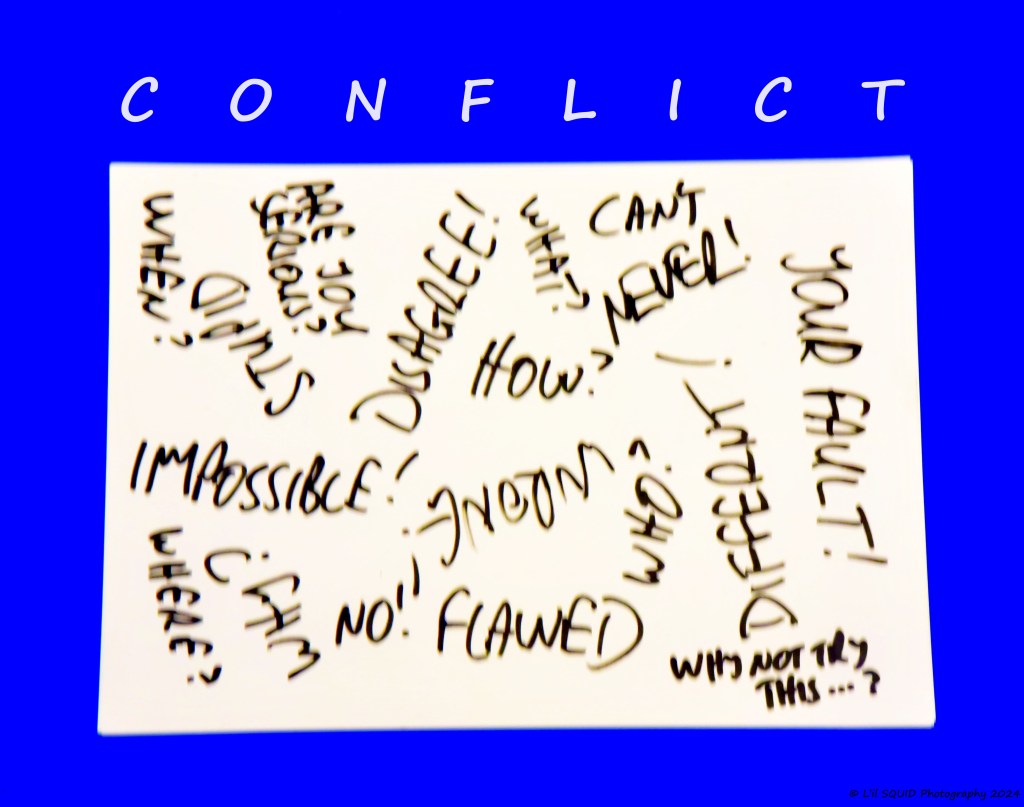
12.8.24
CONNECTION
I remember going on a training course many years ago now where one of the areas covered was the `Big C` – Communication. The trainer told us that effective communication needed to be
- Clear – choosing words carefully so that everybody involved in a communication is applying the same meanings to them.
- Concise – it says what needs to be said and then stops, ensuring that the important information isn’t buried in a way that its importance might be overlooked.
- Complete – nothing important gets missed out because different parties to the communication are making unfounded assumptions about what is important and who to.
- Correct – facts and opinions are clearly indicated, and the reasoning for any assumptions explained, rather than them being presented as if they are facts.
- Courteous – the basic rules of politeness never go astray, because you don’t want the perceived tone of how you said something getting in the way of what you said. It’s a good idea if you think about what you intend to say before you actually let those thoughts out to the rest of the world.
My experience across diverse industries and organisations, projects and teams since then has taught me that the `Biggest C` of all was missing from that training – as it’s been missing from most training I’ve gone through since then. Any guesses about what the `Biggest C` of all is?
If your response was `Connection` – you are right (in my opinion). Communication is not just about moving facts, opinions and assumptions backwards and forwards between the members of your project team, and with stakeholders outside the team. It’s also about creating connections between people who are joined in the context of a project or a team. You are together in the team because you are trying to achieve a shared outcome
Let me share some more important `C` words that help create effective connections:
- Conversation – sharing facts, opinions and assumptions so others know what’s important to you, and why, and you have the opportunity to find out the same for them. `What’s important here is that this isn’t `one-way traffic`, so you need to approach it with an open mind.
- Challenge – not in an aggressive way, but you need to ask questions to understand what’s important to other people and why, because that’s a lot better than making assumptions that might not be true.
- Concur – it’s great when everybody agrees about what needs to happen and how it should be done, but it’s a stage best reached because of conversation rather than despite it.
None of this means you are expected to become best friends with everybody in your team, or whoever else you are interacting with as part of your project, but it doesn’t mean that friendships shouldn’t develop. If you include the C words as part of your thinking and behaviour – TOTALLY AIMED AT CREATING AND MAINTAINING CONNECTION – you will have a foundation for investing more of yourself in individual and collaborative achievement than unnecessary drama.

5.8.24
Brainstorm
This week we have B for Brainstorm. The way your brain naturally works is amazing – there are ideas exploding in all directions at the same time – it’s a real storm going on inside your head. Some you will be more conscious of than others. Some will help you do things that are automatic. Some will help you solve wicked problems, where you know what you’ve done even if you don’t quite understand how or why.
Then you end up in a situation where you have to solve a problem collaboratively – and it’s like some unseen person flicked a switch inside your brain that turns the explosion into a linear thought train. Problem: Even though this is how you’ve probably been taught to solve problems, it doesn’t feel right. Because it doesn’t feel right, you are reluctant to let your thoughts out in front of others – you are judging your own ideas before they get a chance to do it for you. Worse than that, you might be judging yourself for having those ideas.
If you judge yourself more harshly than others do, you keep those thoughts to yourself. That keeps you safe from others’ judgements about your thinking ability – except now they are judging you because you’re not contributing anything to the team. The reality is they don’t have anything of yours to judge. To make matters worse, you may not be the only one in the team going silent. If this happens it becomes a self-reinforcing cycle where good ideas stay hidden because team members aren’t allowing their brains to storm like they naturally do. People are losing confidence in their own ability to think because:
- They are using a thinking style that isn’t natural to them.
- They are imagining judgements that haven’t happened.
Let’s get brave and try capturing some of what your brain does best – those random little thoughts that explode (mentally) in all directions. No judgement – just capturing. No matter how crazy you think they are (because there’s a pretty good chance somebody else in the team will think they are brilliant). For this to happen, everybody in the team needs to share whatever ideas they have – no judging yourself and no judging others. It’s the ideas you are interested in, and those won’t come unless members feel they are in a safe place where they can say what they are thinking. Get ’em out there!
Here’s a little caution worth throwing in (based on lots of lived experience): Never confuse the number of contributions an individual member makes to a storm. Why?
- Some members may feel more comfortable contributing outside the formal storm – forcing them to do it inside the formal storm is going to turn them off and shut down those valuable mental explosions.
- Not all team members are going to process ideas at the same speed. Some need more time to think about what they’ve got, or what’s been shared with them before they let something out.
- Some members may have a different native language – that means they are translating backwards and forwards between two languages before they feel ready to let something out in the common language across the team.
- Some members may come from a cultural background where they way they interact in team situations is not the same as others in the team. Getting to know your team members as individuals is a really useful thing to spend time doing. It’s easier and more respectful to work with how they feel most comfortable than around it or against it.
Good advice here is to put a time limit on the capturing. Yes, more time will likely give you more thoughts, but there also comes a time when the flow of little brain explosions slows down and forcing the process isn’t going to make you feel good – so stop when you reach you set time. Now look at what you’ve captured, because this is where you can start being critical of what you’ve got:
- Can you see any natural groupings of ideas? Organise those groups while things are still fresh in your mind – this will likely spark off some new thoughts that can be added into the storm.
- Are there any ideas that don’t look like they connect to anything you’ve captured yet? Don’t throw them away – connections can still happen later.
- Critique the ideas rather than the person. I’m talking constructive rather than destructive criticism here – the instant you start destructing instead of constructing, the focus is no longer on the ideas and how they will contribute to achieving your project objectives.
Make sure everybody in the team has a copy of the storm so they can think some more about it in their own time outside of the formal brainstorming session. This is important because relevant ideas don’t just happen during whatever time has been allocated for a formal storm.
You can always storm again – you aren’t limited to jut one storm (although there does come a time where you need to stop storming a problem and make something happen.

23.7.24
Achievement
I’m starting a new series within the Thought for the Week. This one’s all about applying the alphabet to collaborative team-based project learning (although it’s still applicable outside the academic/vocational learning space that I usually operate in). Kicking the series off for “A” we have “Achievement.”
When you join a team or start working on a project, something that’s bound to be going through your mind is the topic of Achievement. Whether it’s what the team is able to do, or what you are able to do yourself, you are in the middle of a battle between what you would like to do, what you think you are capable of doing, what other people would like you to do, what other people think you are capable of doing, what circumstances beyond your control mean will actually be possible… Let’s throw a bit of `what’s been done before` into the mix and you start to understand that the same achievement can mean different things to different people for different reasons.
You might be in a situation where the achievement outcomes have already been set before you arrived, in which case you need to work out what you need to do in order to meet them. Where they aren’t fixed, though, you have room for negotiation. The more input you have into creating the achievement outcomes you will be working towards, and the means by which you will be doing that, the more incentive you have to invest yourself in achieving them.
Let me add in some more A words that have parts to play in Achievements:
- Advice – sometimes you will know you need it, and sometimes other people will think you need it. Think about it carefully rather than just blindly accepting it. What knowledge and experience does the giver have that match situations similar to yours? You may have to balance something that looks or sounds too good to be true against something that your first instinct says is wrong because it doesn’t match your existing knowledge or beliefs. Remember that being different isn’t the same as being wrong. How are you going to express advice when you are giving it so that the people on the receiving end can focus more on the content than the giver? It’s worth taking the time to learn something about who’s going to be on the receiving end so that you can position your advice as helpful rather than confrontational.
- Alliance – humans are mostly social creatures, and most of us like to be liked by others. We may feel more comfortable with people who think the same way we do, and that might lead to a natural alliance in a team. Not every alliance, however, will based on agreement for positive reasons – sometimes people try to create alliances against other people who are different to them, or who think differently to them. Just because somebody wants you to ally with them doesn’t automatically mean you should – if the reason for the alliance is a negative one, trust your gut feeling about what it would feel like to be on the receiving end of it and give that alliance a miss. You instinctively know that there is a difference between friendship. professionalism, and compulsion.
- Alignment – before you open your mouth or commit yourself to text, think about how what you’re doing aligns with the stated vision and values of your team, or the organisation you are part of. How does it align with the stated values and vision of the organisation whose problem you are trying to solve or opportunity you are trying to help them take advantage of? If there’s an alignment gap, is there something you can do to close the gap, or might you have to accept yours isn’t the most appropriate advice for the situation?
- Awards – it’s nice to get them, because it means that somebody else has recognised you for what you’ve done and how well you’ve done it. They might also be recognising the contribution you’ve made to quality of life for others. What you need to decide here is whether you are chasing awards primarily because that’s what strokes your ego (not that there’s anything wrong with a little ego-stroking from time to time), or because you want to be the best version of you that you can be, doing awesome things to solve wicked problems or take advantage of wicked opportunities.
Sometimes the most important achievements might be the ones that are intensely personal to you, but the fact that they aren’t right out in the open for everybody else in the team to know doesn’t make them any less valuable. It’s not how much money you spend on recognising and celebrating an achievement that matters; it’s the fact that you didn’t devalue the opportunity to do it.

15.7.24
Celebrate the Darkness AND the Light
As a child I remember being afraid of the dark, sometimes to the point where I could not sleep because of creatures and things I could not see, despite the fact that I was in familiar surroundings. Of course, the reality is that the bad things I thought existed in the darkness were figments of a very active imagination.
It wasn’t really until I started getting seriously interested in photography around 5 years back that I started to see the darkness as something I could celebrate. Instead of being full of scary, nasty things, it makes it possible for me to see familiar things in different and exciting ways that aren’t possible during daylight. That’s why I’m sharing two images this week – the same cabbage tree (tī kōuka) seen in the darkness and how it could look when seen in the bright light of day.
Is either one of these images “right” (meaning the other one must be “wrong”) ? No – they are BOTH “right” and each one brings something beautiful and special to how we can appreciate this wonderful tree.
This is a lesson that I’ve carried across to my work with collaborative team-based project learning and how that deals with wicked problems and opportunities. Being able to look at situations in multiple ways, with the constraints of old beliefs put to one side, means new ways of thinking and doing, creating beautiful new solutions that wouldn’t have been seen with those constraints in place. Celebrate the Darkness AND the Light – bringing them together makes amazing things possible, and only requires a little bravery to step outside where you thought your comfort zone was. Not only that, the more you look at the Darkness AND the Light the easier it becomes to keep having those amazing adventures of discovery. Stay open to possibilities, because that’s where the magic happens.


8.7.24
Conditioned by convention
Often we find ourselves conditioned by convention into believing that something has to be a particular way, which limits our options when we are trying to solve wicked problems or take advantage of wicked opportunities. This image that I captured at the weekend is a perfect example. What you see here is a magnolia bud at the end of a branch. Anybody who knows anything about plants in general, and magnolias in particular (and who has the eyesight to see it) knows that the branch is brown and the outer surface of the bud is a green/gold (in the right light). Conventional wisdom says that’s how it is, and we all go along with it because – we just do…
What if the conventional wisdom wasn’t the only way to see this? What if the branch and bud were different shades of purple instead? Our conditioning acts to stop us accepting such an idea, but is there any reason aside from our conditioning that means such a thing could not be true? It takes a conscious effort to suspend that conventional thinking and accept any other possibility. That’s what effective problem solving is all about – accepting that what we have been conditioned to believe doesn’t have to be the only answer.

1.7.24
Often
BARRIERS
Barriers are amazing things. They can exist in tangible form; or hide intangibly in our minds. They can be prescribed as formal rules; or come to be accepted as custom or culture handed down from the oldies to the newbies in an industry or organisation. They can be regarded as “chiselled in stone”- but when we regard them as incapable of being challenged or modified, we make them real obstacles to creativity, innovation and progress. Let us be brave barrier-breakers rather than slavish barrier-makers.

24.6.24
YOU ARE SOMEBODY’S LIGHT
You never know from the outside what battles somebody else is fighting on the inside. Their reasons for keeping them hidden may not be the reasons you would choose in a similar situation, but that doesn’t make theme any less valid for them. You could spend your time judging them – probably wrongly, and definitely not helpfully.
When somebody else is having a dark time, you may just be the light they are looking for to help them find their way into a better situation. Don’t wait for them to tell you that you are their light, because they may not do that. Just shine brightly through the example you set with your words and your actions. It costs nothing to be a good person and shine your light for others to find when they need to.
17.6.2024
Be your authentic self as a leader
If you’ve ever tried being all things that you think all people expect you to be, you’ve probably mentally turned yourself inside out trying to work out what that would look, sound, feel like…and not come up with an answer that you are particularly happy with. The problem with that is that you end up like the text in this image – blending into an anonymous background that lacks colour, presence, personality, life…
There’s a simple solution to this blending-out-of-the-picture. Be your authentic self – all the time. You’ve had a lifetime of experience being that person, and you do it better than anybody else ever could. Shine brightly for all the world to see and enjoy being you. When you stop worrying about how you think other people expect you to be, you have so much more energy to put into being you, and so much more to share with the people you are leading.
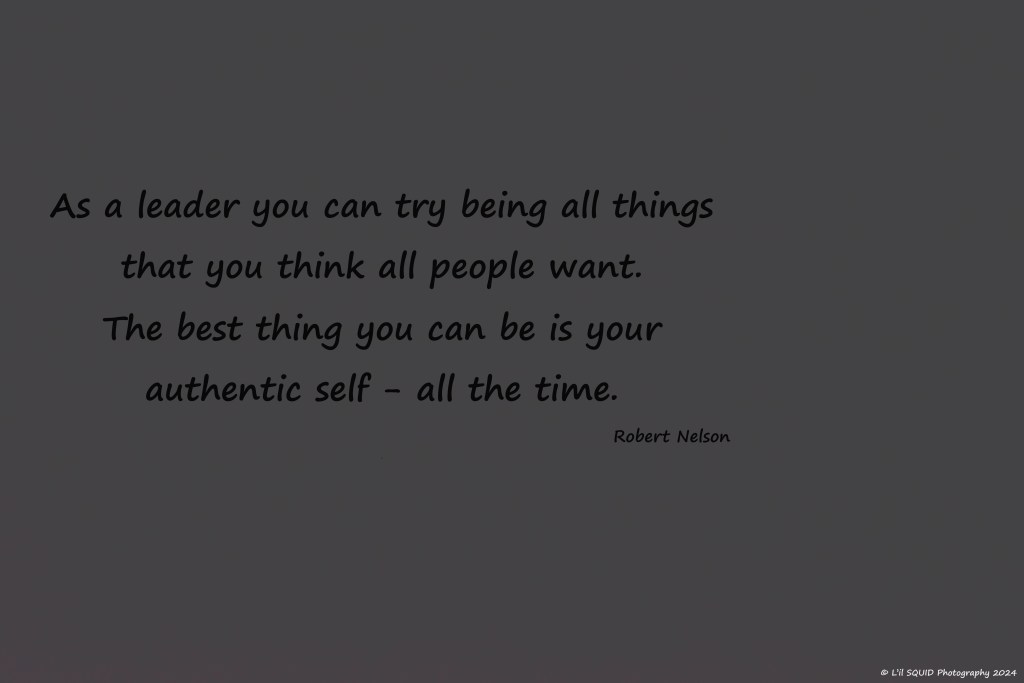
10.6.24
Leadership Lessons from Snowy The Cat: Walk with purpose wherever you go
As I write this week’s thought, I’m up to my ears in work with deadlines (some of which I’m manipulating a little bit here and there) and I have 10 days until the Thesis Monster Thingy and its Book Sibling are submitted for peer review (with SO much work still to do on both of them). Remind me again why I thought doing a doctorate was a great idea…
I need look no further than our Snowy The Cat for leadership advice that makes perfect sense right now: Walk with purpose wherever you go.
Every thought, every action, every step – they all have a purpose in your journey, and you’ve been thinking about and planning this journey for a long time. You can wait for the rest of the world to fall in love with your purpose – and there are people to whom it is important you communicate your purpose. Even when you have communicated your purpose, not everybody will believe it it – or believe in you. Find the ones who do – even if it’s not their purpose. Share your energy and your dreams with them, because it’s YOU they believe in. Draw from the strength they offer you through their belief when the going is hard – they are offering it because it’s the right thing to do, not because they have to. They know you have a valuable contribu7tion to the world that you haven’t finished making yet.
Walk with purpose wherever you go.

3.6.2024
The word you owe yourself – NO
When life feels like it is spinning at an ever-faster rate, and you feel like you don’t know which way is up any more and you’re about to lose your grip and fly right off the edge…
There’s a very special word you owe to yourself (and others). It’s only two letters long, and it’s (reputedly) one of the hardest words in the English language to say because we know it’s not the one the person on the receiving end wants to be hearing or seeing. Because we don’t want to upset people – we are concerned about the impact that might have on our continuation in the team, project, or even organisation – we try our best to avoid saying that word. What is that word?
NO.
It doesn’t matter how brilliantly capable you think you are of multi-tasking, or how complex the ideas are that you can handle. Kahneman made the point in his 2011 book Thinking, fast and slow, that there are limits to what we can deal with effectively.
Do yourself a favour when the spinning feels like it’s getting too much: Say NO. NO to taking on another task until this one is finished. NO to adding more to the task you already have. NO to sitting on that chair in front of those screens so long that the only exercise you get is your fingers dancing across they keyboard and your eyes flicking from one screen to the other and back again. NO to working so many hours that your loved ones are forgetting who you are and how you fit into the family…
Make a time to stop and take stock of everything that everybody else expects you to do (and you expect yourself to do). Prioritise those things – be ruthless if you have to. Take some things off that list as necessary. You are better to do fewer things but do them really well than you are to do more things and do them all poorly.
Understand this: If you crash and burn because NO was too hard to say, there’s a good chance nobody will really appreciate your willingness to keep saying YES. There’s a good chance that very few people will show interest in helping pick you back up again. Take this opportunity to practice self-care by saying NO. You owe it to everybody else but, most of all, you owe this word to yourself – NO.